

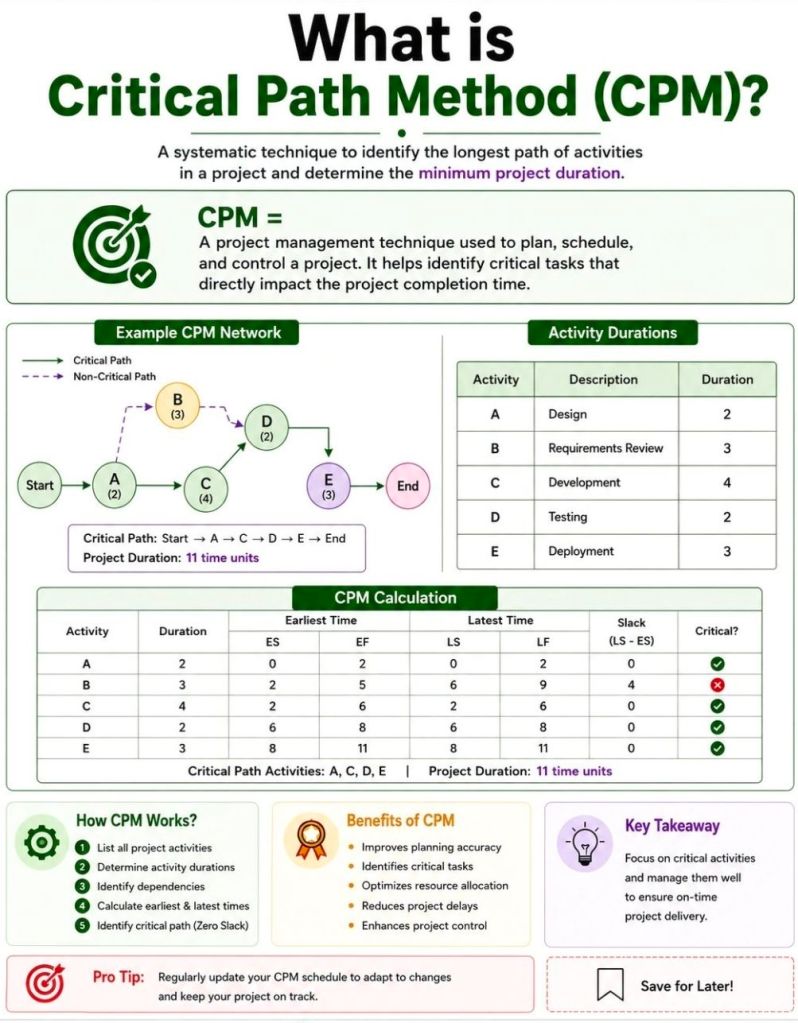
The Critical Path Method (CPM) is a project management algorithm used to identify the longest sequence of dependent tasks required to complete a project. It establishes the shortest possible project duration and highlights the “critical” activities that cannot be delayed without extending the entire project’s deadline.
How the Critical Path Works
CPM relies on finding the path through your project’s workflow that takes the most time from start to finish.
- Critical Activities: Tasks on the critical path have zero “float” (or slack), meaning any delay directly impacts the final delivery date.
- Non-Critical Activities: Other task sequences may have buffer time, allowing them to be delayed without throwing off the main project timeline.
Steps to Calculate the Critical Path
- Identify Tasks: Break the project down into individual activities (often using a Work Breakdown Structure).
- Determine Dependencies: Map out which tasks must happen before others can begin.
- Estimate Durations: Assign a realistic time frame for completing each task.
- Draw a Network Diagram: Create a flowchart visually connecting tasks with arrows to illustrate the sequence.
- Analyze the Paths: Calculate the total duration for every possible sequence of tasks. The longest sequence is your critical path.
Key Terminology
- Float (Slack): The amount of time a task can be delayed without causing a delay to subsequent tasks or the overall project.
- Forward Pass: A calculation used to find the Earliest Start and Earliest Finish times for each task.
- Backward Pass: A calculation used to find the Latest Start and Latest Finish times for each task before the project is delayed.
When and Why to Use It
Project managers use CPM during the planning phase to build realistic schedules and set clear baselines. It is highly beneficial for complex, predictable projects like construction or software rollouts, where many tasks rely on the completion of previous ones.
By knowing exactly which tasks control your timeline, you can prioritize resources, prevent bottlenecks, and use “fast-tracking” (doing tasks in parallel) if you need to compress a timeline.
To get started with building a timeline, you can map out your workflows using digital tools such as Asana’s Critical Path Guide, Wrike’s CPM Implementation, or Monday.com’s CPM Tutorial.


