

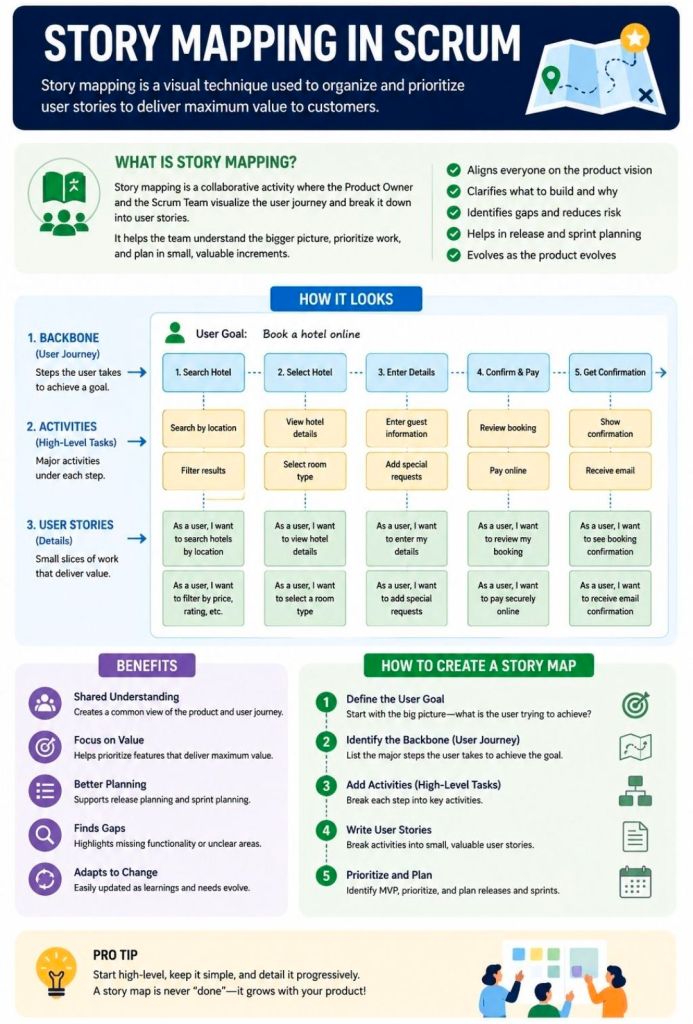
Story Mapping in Agile and Scrum is a visual technique that organizes user stories along a chronological user journey. It helps teams see the big picture, avoid flat, disconnected backlogs, and collaborate on planning iterative releases that consistently deliver user value.
How a Story Map is Structured
A story map is a two-dimensional grid—often built with sticky notes on a whiteboard or via software like Miro or Visual Paradigm. It breaks work down into three levels of hierarchy:
- Horizontal Axis (The Spine): Arranges the customer journey chronologically.
- Activities: The broadest goals a user wants to achieve (e.g., “Checkout”).
- Steps: The specific tasks required to complete the activity (e.g., “Enter Shipping Info,” “Pay”).
- Vertical Axis (Details & Priority): Stacks beneath each step are the detailed user stories, epics, or features. They are organized by priority, with the most critical or highly sophisticated tasks at the top.
The Benefits of Story Mapping
Teams use this technique—popularized by Jeff Patton—to achieve several core Agile goals:
- Prevents “Flat Backlog” Blindness: Gives stakeholders and developers a birds-eye view of how the entire application or feature fits together.
- Defines the MVP: Allows teams to draw horizontal “release lines” across the map. The items sitting above this line form the barebones “walking skeleton” or Minimum Viable Product (MVP).
- Aids Sprint Planning: Helps the Product Owner pull well-sequenced, context-aware stories directly into sprint backlogs.
- Fosters Collaboration: Moves the team away from siloed requirement docs and toward collaborative conversations around actual user behavior.

