

Popular Computing Weekly (frequently abbreviated as PCW) was a highly influential British computer magazine published from 23 April 1982 to 14 June 1990.
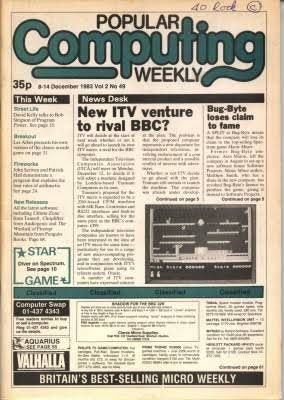
Launched by Sunshine Publications and led by founding editor Duncan Scot, it stood out by providing rapid-fire weekly news, hardware reviews, type-in software programs, and gaming coverage at the height of the UK’s home microcomputer boom.
Over its eight-year lifespan, it produced 415 issues, adapting its identity from a broad hobbyist guide to a gaming-centric publication before closing in the early 1990s.
Magazine Overview & Core Elements
Unlike glossy monthly publications such as Personal Computer World or Your Computer, Popular Computing Weekly acted as a fast-paced “newspaper” for the UK micro community. Because it hit newsagent shelves every seven days, it could report on dramatic price drops, industry buyouts, and hardware delays weeks before monthly rivals.
The magazine catered to a wide array of early systems, including the ZX Spectrum, Commodore 64, BBC Micro, Amstrad CPC, Atari 8-bit, Dragon 32, VIC-20, and later the 16-bit machines. Its format generally consisted of:
- News Desk: Urgent industry reporting, micro-market trade wars, and launch delays.
- Hardware and Software Reviews: Critical evaluations of new home computers and software titles.
- Type-In Listings: Pages of raw BASIC or Machine Code that readers meticulously copied into their systems to run games and utilities.
- Gaming Coverage & Puzzles: Dedicated spaces for arcade game high scores, maps, and adventure hints.
Detailed Timeline Breakdown (1982–1985)
1982: Launch and the 8-Bit Explosion
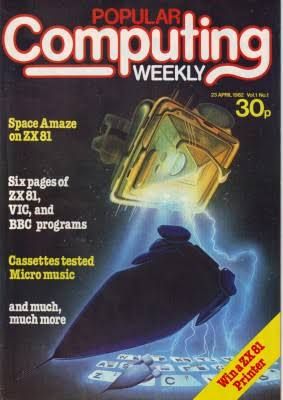
- April: On 23 April 1982, Issue 1 was published by London-based Sunshine Publications. The launch editor, Duncan Scot, managed the first 8 issues before handing the reins over to Brendon Gore.
- May–June: The magazine’s debut directly coincided with Sir Clive Sinclair’s unveiling of the ZX Spectrum. Popular Computing Weekly quickly positioned itself as a critical hub for Spectrum and BBC Micro setup guides and technical support.
- System Agnosticism: Early volumes accommodated a highly fractured market, including type-in listings for the ZX81, VIC-20, Acorn Atom, TRS-80, and early Apple II systems.
- Cover Price: The early issues cost just 30p.
1983: Price Wars and Rising Circulation
- The Boom Year: Home computing exploded in the UK. PCW capitalised on its fast turnaround to report on brutal, ongoing price slashes initiated by Commodore, Sinclair, and Atari.
- Market Diversification: Content expanded heavily to track new contenders like the Oric-1, Dragon 32, and the newly launched Commodore 64.
- Commercialisation: Software companies grew rapidly. Advertising pages surged with multi-page spreads from early publishing giants like Imagine Software, Ocean Software, and Ultimate Play The Game.
1984: Amstrad’s Arrival and Market Shocks
- April: The magazine closely documented Alan Sugar’s entry into the computer market with the Amstrad CPC 464, which changed the landscape by packaging a computer, keyboard, and monitor into an all-in-one unit.
- The Crash Warning: PCW reported extensively on the high-profile financial collapse of Imagine Software and structural corrections across the British software industry.
- The MSX Standard: The magazine devoted substantial print space to tracking the arrival of Japanese MSX standard computers (such as Toshiba’s HX-10) attempting to break into the UK.
1985: Transition to 16-Bit and Gaming Domination
- January: The magazine followed the rocky release of the business-oriented Sinclair QL and the debut of the dual-mode Commodore 128.
- May: The news desk shifted focus to the 16-bit horizon, tracking early announcements for the Atari 520ST and Commodore Amiga.
- Pricing: Driven by inflation and increased page counts, the cover price rose to 40p.
- Software Pivot: As users grew tired of typing in complex code by hand, the publication reduced its raw code listings and pivoted towards dedicated, full-colour video game previews, software reviews, and maps.
Post-Early Eighties Legacy (1986–1990)
Beyond its golden era, the publication continued to evolve through the late 1980s. By 1989, regular home micro content declined as the industry consolidated around IBM-compatible PCs, the Amiga, and the Atari ST. To compensate for falling sales, PCW incorporated Computer Gamesweek in 1989, morphing almost entirely into a video games magazine.
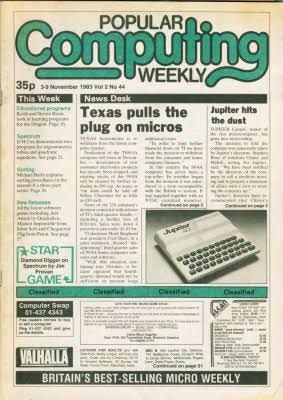
Sunshine Publications eventually closed the magazine on 14 June 1990 with its 415th issue, ending its run as a primary historical record of the 1980s British microcomputing phenomenon.

