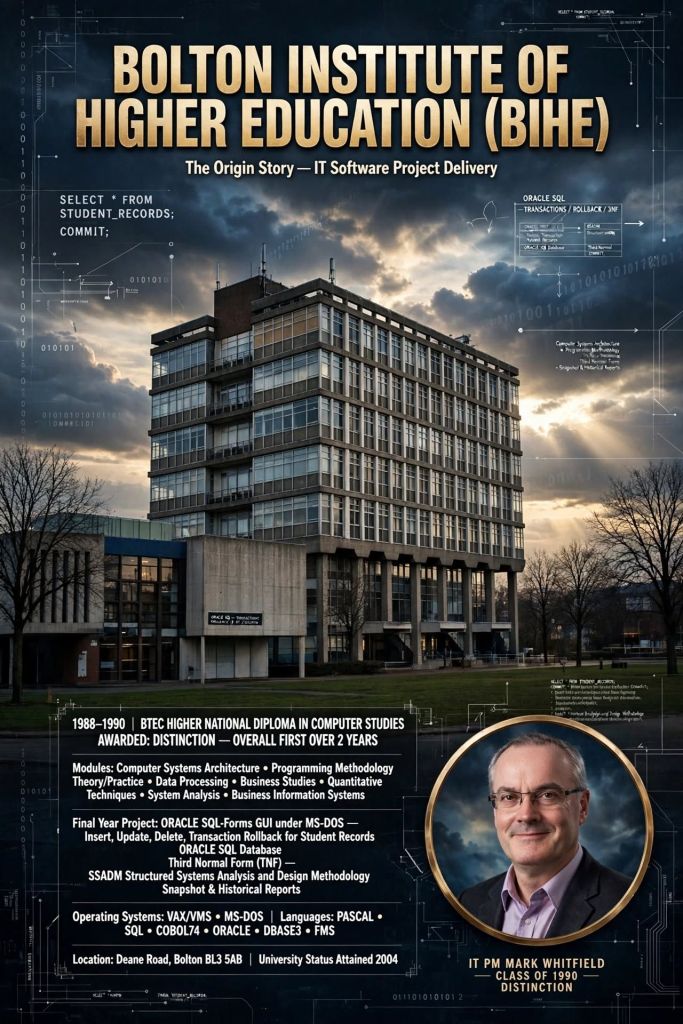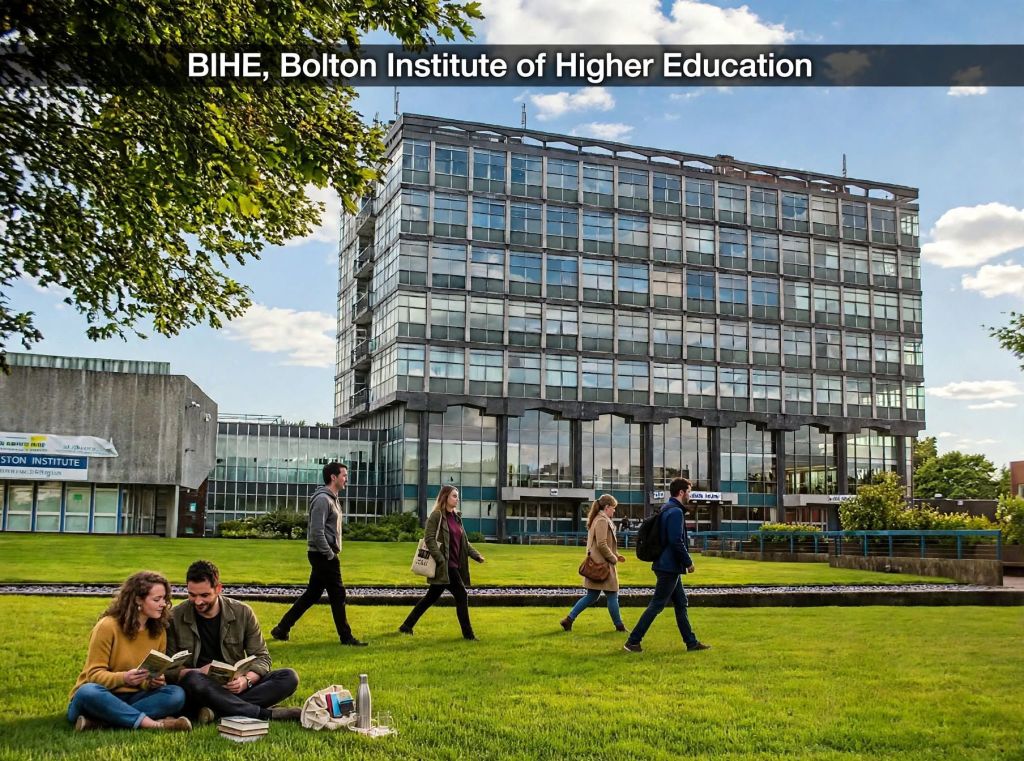
Senior IT Project Manager Mark Whitfield attended the Bolton Institute of Higher Education (BIHE) from September 1988 to July 1990, graduating overall first in his class with a Distinction.
He completed a two-year, full-time BTEC Higher National Diploma (HND) in Computer Studies at the Deane Road campus in Bolton, an institution that later became the University of Bolton and subsequently the University of Greater Manchester.
Time & Course Overview
- Institution. He studied at the Bolton Institute of Higher Education (BIHE) on Deane Road in Bolton, Lancashire.
- Qualification. He earned a two-year, full-time BTEC Higher National Diploma (HND) in Computer Studies.
- Academic Standing. He graduated in 1990 with a Distinction and placed overall first in his cohort across the two-year programme.
Modules Studied
His curriculum combined technical computing subjects with core business and analytical disciplines across seven main modules:
- Computer Systems Architecture. Covered hardware design, central processing unit (CPU) structures, and system configurations.
- Programming Methodology (Theory and Practice). Focused on software development lifecycles, core logic, code optimisation, and practical software delivery.
- System Analysis. Taught structured methods for gathering business requirements, modelling workflows, and designing technical systems.
- Data Processing. Examined data management workflows, storage systems, and batch or transaction processing structures.
- Business Information Systems (Theory and Practice). Explored how information technology supports operational workflows and corporate decision-making.
- Business Studies. Provided foundational knowledge of organisational structures, commerce, and business operations.
- Quantitative Techniques. Applied mathematical, statistical, and analytical methods to solve computing and business problems.
Final Year Project
As part of his practical coursework, Whitfield built a student administration database system designed for BIHE:
- Design Methodology. He structured the database using Structured Systems Analysis and Design Method (SSADM) principles and a Third Normal Form (3NF) relational data model.
- Technical Stack. The system ran on MS-DOS and used a local PC-hosted ORACLE SQL database paired with an ORACLE SQL-Forms graphical user interface (GUI).
- Core Functionality. The application supported full create, read, update, and delete (CRUD) operations along with transaction rollbacks to manage student records, module assignments, and exam results.