

Here is the detailed historic timeline of Bangor University, from its 19th-century foundation through to the present day.
🏛️ The Foundation & Victorian Era (1881–1899)
- 1881: A government report by Lord Aberdare recommends establishing a university college in North Wales.
- 1883: A “beauty contest” takes place between 13 rival North Wales towns competing to host the site. Bangor wins the bid. Local farmers and quarrymen raise over £1,200 via community crowdfunding.
- 1884: The University College of North Wales (UCNW) opens its doors on 18 October inside the Penrhyn Arms, a converted 18th-century coaching inn. It begins with 58 students and 10 academic staff. Mary Ellen Williams, a local grocer’s daughter, is the first student to enrol.
- 1885: The institution is officially incorporated by Royal Charter.
- 1893: UCNW ends its initial degree-conferring relationship with the University of London to become a founding constituent college of the federal University of Wales.
🧱 Expansion & The World Wars (1900–1945)
- 1903: The City of Bangor donates a prominent 10-acre site at Penrallt for a grander campus building.
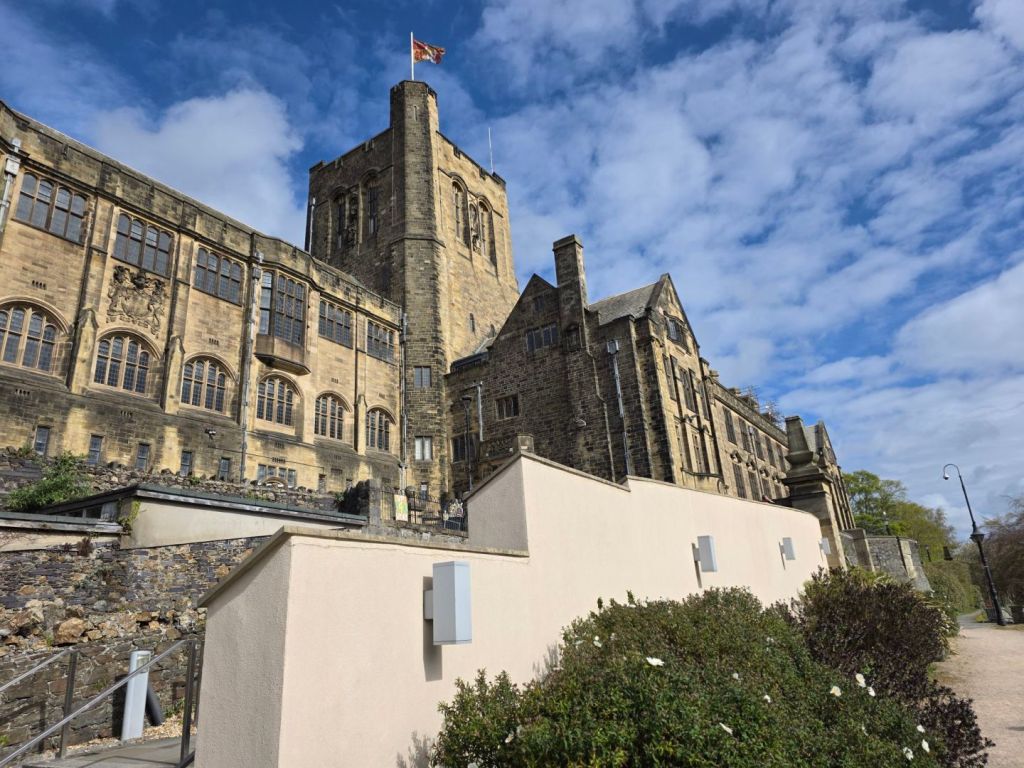
- 1907: The foundation stone of the iconic Main Arts Building is officially laid.
- 1911: The grand, hilltop Main Arts Building opens, housing the main library, arts, and social science departments.
- 1926: The university’s Science Departments move into newly built, purpose-designed facilities.
- 1939–1945 (World War II): Bangor serves as a safe haven. Masterpieces from London’s National Gallery are secretly hidden in the Prichard-Jones Hall. Staff and students from University College London (UCL) are evacuated here to live and study.
🏗️ Post-War Growth & Modernism (1946–1999)
- 1946: Student populations begin expanding rapidly, jumping from 500 at the end of WWII to 2,500 by 1970.
- 1963: The mid-century modern New Arts building is constructed.
- 1969–1971: Architect Sir Percy Thomas designs a “space-age” science campus. The brutalist Brambell Laboratory is constructed for the Zoology department.
- 1996: The historic Bangor Normal College (founded in 1858) is integrated into the university, significantly boosting its teacher training profile.
🎓 The 21st Century & Modern Era (2000–Present)
- 2007: The institution undergoes a complete rebrand, officially changing its name from the University of Wales, Bangor to Bangor University (Prifysgol Bangor).
- 2009: The university celebrates its 125th anniversary with major investment projects in staff and campus restructuring.
- 2014: The university opens the Pontio Arts and Innovation Centre, a multi-million-pound hub combining student social spaces, a theatre, a cinema, and innovation labs.
- 2019: The CaBan Initial Teacher Education (ITE) partnership launches its first modernised courses under the new Welsh educational framework.
- 2024: Bangor University marks its landmark 140th anniversary, celebrating its journey from a 58-student coaching inn to a major global research university.
Bangor University Gwynedd LL57 2DG detailed timeline by era and year


