

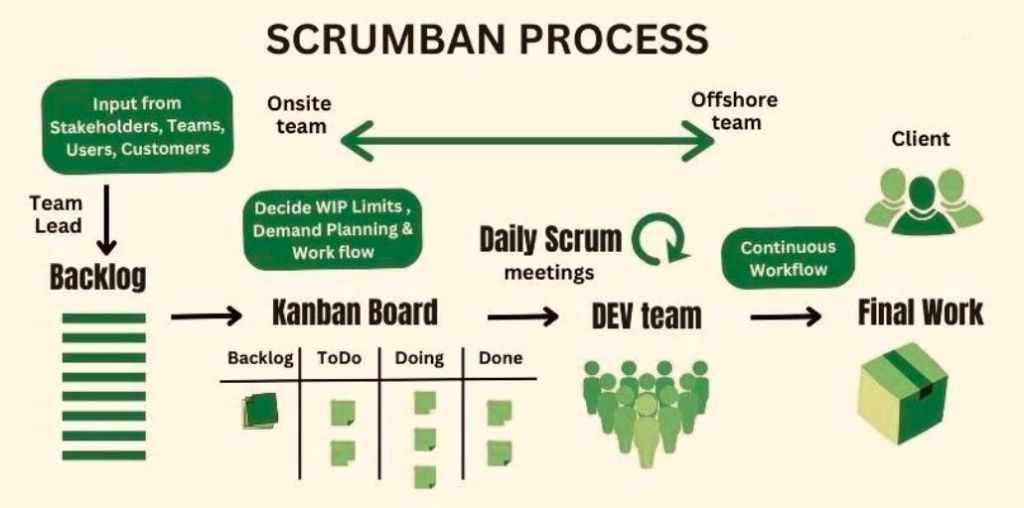
Scrumban is a hybrid Agile project management framework that blends the structured planning and roles of Scrum with the continuous flow and visualization of Kanban. Originally designed as a transition method for teams moving from Scrum to Kanban, it has evolved into a popular, distinct approach for teams needing to manage unpredictable work (e.g., support, maintenance) while maintaining prioritized planning. It focuses on pull-based workflows, limiting Work-in-Progress (WIP), and continuous improvement.
Scrumban Summary
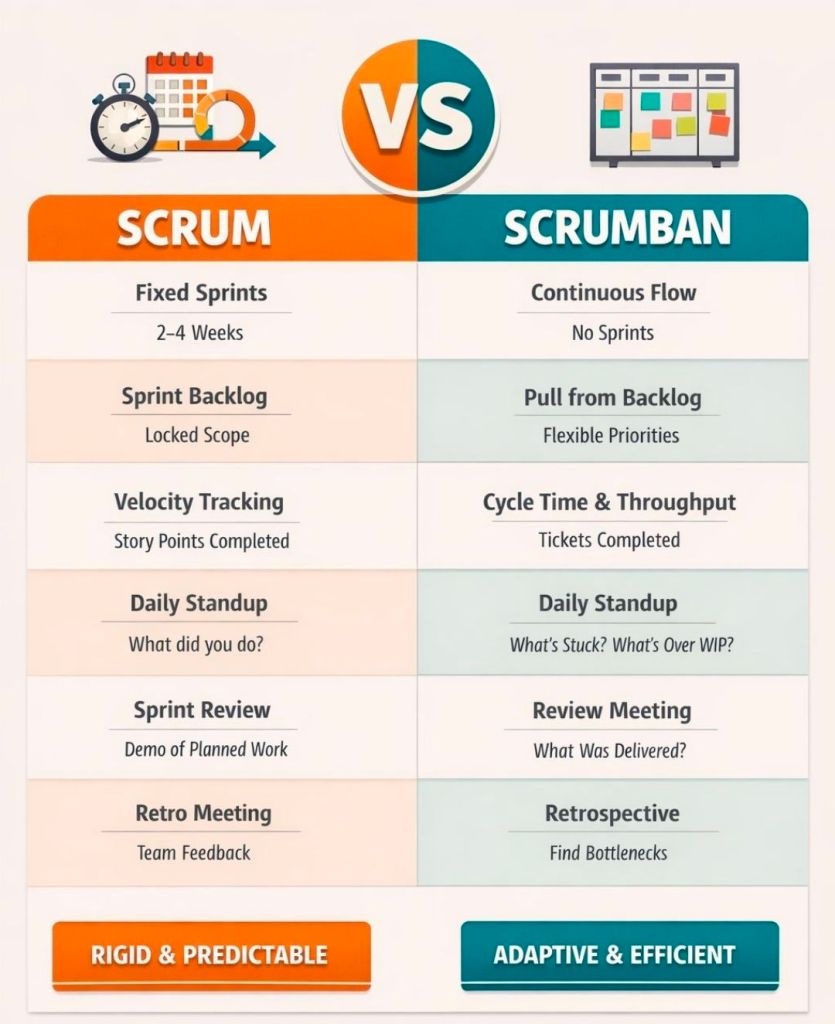
- Best Used For: Teams needing more flexibility than Scrum (no rigid sprints) but more structure than Kanban (needs planning cycles).
- Key Features: Visual board (Kanban), Work-in-Progress (WIP) limits, on-demand or iterative planning, and a pull-based workflow.
- Differences from Parent Frameworks:
- vs. Scrum: No set sprint length or rigid roles; work is pulled continuously rather than planned in batches.
- vs. Kanban: Uses planning meetings and team retrospectives, whereas classic Kanban is purely continuous.
Detailed Historical Timeline of Scrumban
1. The Pre-Scrumban Era (Pre-2008)
- 1950s (Kanban Origin): Toyota develops Kanban to optimize manufacturing production processes, focusing on Just-in-Time (JIT) production.
- 1986 (Scrum Concept): Takeuchi and Nonaka introduce the “rugby” approach to product development in the Harvard Business Review, fostering flexible, team-based development.
- 1995 (Scrum Introduced): Ken Schwaber and Jeff Sutherland formalize the Scrum framework for software development.
- 2001 (Agile Manifesto): Release of the Agile Manifesto, establishing core agile principles.
- 2004 (Kanban in Software): David J. Anderson suggests applying Kanban practices to software development to improve workflow.
- 2000-2007 (Evolution): Microsoft teams begin experimenting with “feature crews” that mix structured planning with continuous delivery, planting the seeds for hybrid approaches.
2. Conception and Definition (2008–2010)
- 2008: Corey Ladas coins the term “Scrumban” and introduces the concept in his work, proposing it as a mechanism for teams to transition from Scrum to Kanban, or as a sustainable hybrid for maintaining focus while reducing iteration overhead.
- 2008: Ajay Reddy discusses the “Scrumban (R)evolution,” emphasizing that Scrumban is a distinct, powerful approach, not merely a blend.
- 2009: Ladas publishes “Scrumban: Essays on Kanban Systems for Lean Software Development,” providing the definitive framework for the approach.
3. Formalization and Adoption (2011–2019)
- Early 2010s: The methodology gains popularity in specialized software areas, such as maintenance and support teams, where unpredictable bugs demand faster flexibility than two-week sprints.
- 2016: Ajay Reddy releases “The Scrumban [R]Evolution: Getting the Most Out of Agile, Scrum, and Lean Kanban,” providing practical guidelines for applying the methodology.
- 2018-2019: Adoption expands beyond software development into agile marketing and HR, looking for reduced bureaucracy.
4. Mature Hybrid & Continued Growth (2020s–Present)
- 2020s: Scrumban is recognized as a standard agile framework within major project management tools (e.g., Jira, Miro, Monday).
- 2025-2026: Further refinement as teams integrate AI-driven task management with visual Kanban workflows to increase throughput and automate WIP tracking.
Core Principles of Modern Scrumban (2026 Perspective)
- Pull System: Work is pulled by team members when capacity allows, rather than pushed into the team.
- Visual Board: All tasks are visualized to show bottlenecks.
- WIP Limits: Restricting the number of active tasks at any stage to improve efficiency.
- No Required Roles: Teams can keep Scrum roles (Product Owner, Scrum Master) or remove them, depending on their needs.
- Adaptive Planning: Planning occurs on-demand or at short intervals, not just in strict timeboxed sprints.
Scrumban project management summary and detailed historical timeline by era and year
 PROject Templates