

Project Management Professional (PMP) history, as guided by the Project Management Institute (PMI), tracks the evolution from ancient craft systems to a modern, standardized profession combining predictive, agile, and hybrid approaches. Modern project management as a formal discipline emerged in the 1950s, with PMP certification officially launching in 1984.
Summary of Project Management Eras
- Pre-1950s (Craft Era): Large-scale construction (Pyramids, Great Wall) relied on master builders, intuitive planning, and heavy labor.
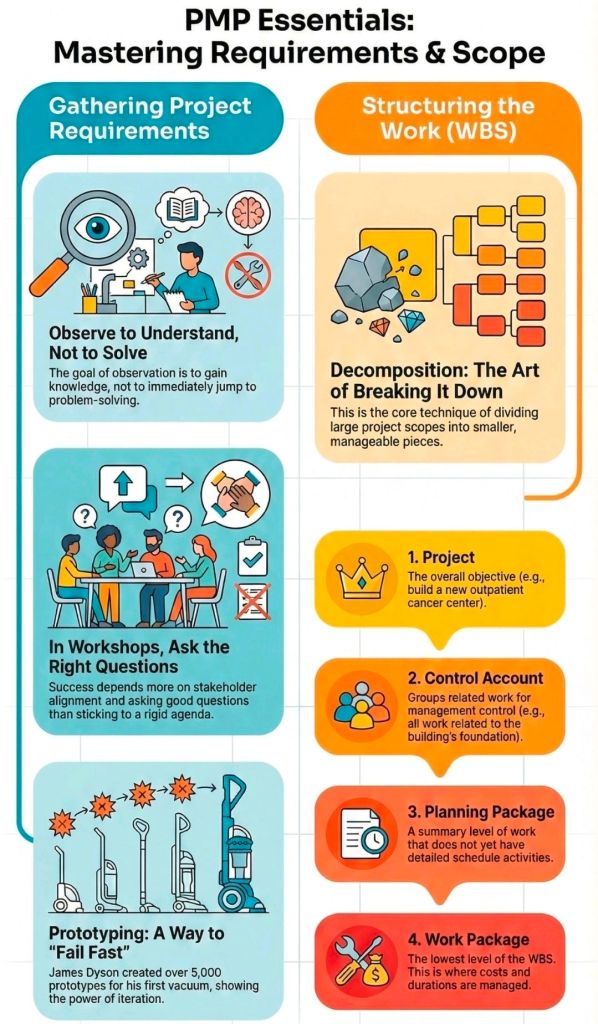
- 1950s-1960s (Birth of Modern PM): Scheduling tools (CPM, PERT) and the Work Breakdown Structure (WBS) were developed for defense and construction.
- 1969-1980s (Standardization Era): PMI was founded, and the PMP certification was introduced to create a shared professional language.
- 1990s-2000s (Digital & Agile Era): Project software matured, the PMBOK Guide was published, and Agile techniques began reshaping software development.
- 2010s-Present (Hybrid & AI Era): Focus on flexibility, stakeholder management, hybrid approaches, and AI integration.
Detailed Historical Timeline
Ancient to Early 20th Century: Foundations
- 2570 BC: Completion of the Great Pyramid of Giza, showing advanced resource planning.
- 208 BC: Construction of the Great Wall of China, demonstrating large-scale logistical management.
- 1917: Henry Gantt develops the Gantt Chart, a cornerstone of project scheduling.
1950s-1960s: Birth of Modern Project Management
- 1957-1958: Development of key scheduling tools, Critical Path Method (CPM) and Program Evaluation Review Technique (PERT).
- 1962: WBS approach mandated by the U.S. Department of Defense.
- 1969: Project Management Institute (PMI) founded in Pennsylvania to standardize the profession.
1970s-1980s: Professionalization and Certification
- 1975: Publication of The Mythical Man-Month by Fred Brooks, identifying software project risks.
- 1984: First PMP certification exam administered by PMI.
- 1986: Takeuchi and Nonaka introduce “Scrum” as a project management style.
- 1987: First PMBOK Guide published as a white paper.
1990s: PMBOK and Formalization
- 1996: First official edition of A Guide to the Project Management Body of Knowledge (PMBOK Guide) published.
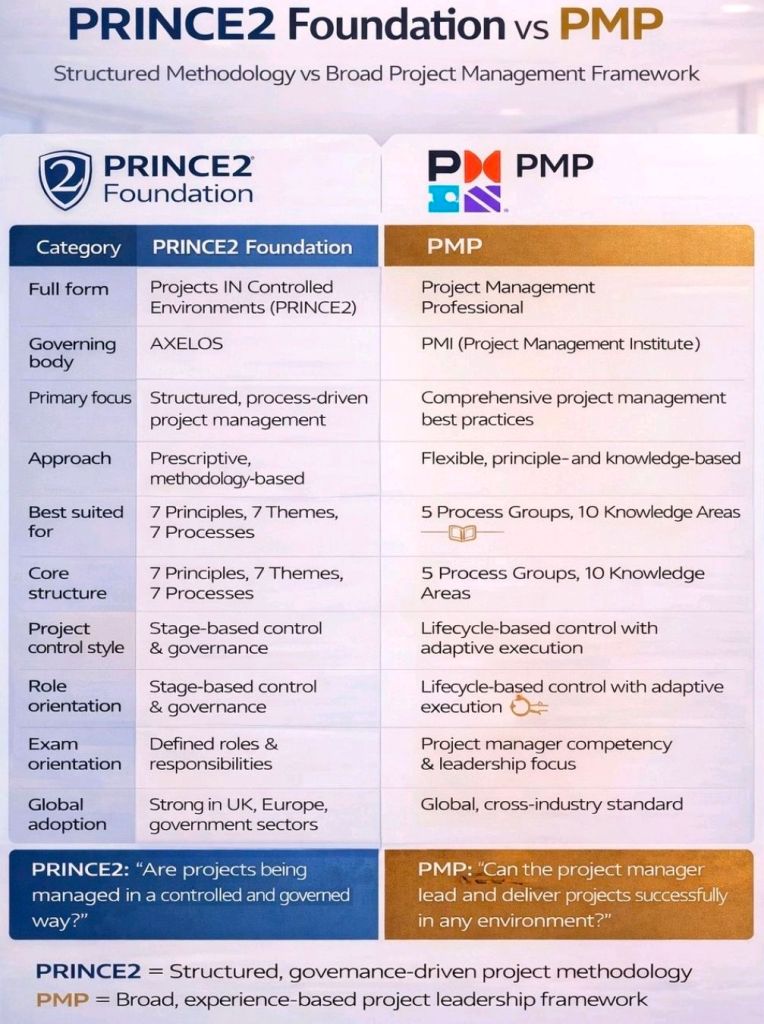
- 1996: PRINCE2 published as a generic management method.
- 1998: PMBOK recognized as an ANSI standard.
2000s-2010s: Agile and Global Expansion
- 2001: Agile Manifesto written, emphasizing flexibility.
- 2003: PMP exam revised to incorporate Agile techniques.
- 2017: PMBOK 6th Edition released, integrating Agile and adaptive environments.
2020s-Present: Modernization and AI
- 2021: PMBOK 7th Edition released, shifting from process-based to principle-based standards.
- 2024: PMI launches initiatives to incorporate Generative AI (PMIxAI) into project management.
Key Evolution Trends
- From Craft to Science: Moving from intuitive, “master builder” approaches to structured, data-driven methodologies (PERT/CPM).
- From Fixed to Adaptive: Transitioning from rigid “waterfall” plans to iterative Agile and Hybrid approaches.
- Standardization: The PMP credential has shifted from solely construction/engineering focus to a global, cross-industry benchmark.
- Technology Integration: The rise of Artificial Intelligence (AI) and automated tools for risk management and scheduling.
PMP Project Management Professional summary and detailed historical timeline by era and year

 PROject Templates