Periphonics Corporation pioneer in Interactive Voice Response (IVR) Timeline

Periphonics Corporation, founded in 1969, was a pioneer in the Interactive Voice Response (IVR) industry. The company evolved from a boutique voice response manufacturer into a key subsidiary of global telecommunications giant Nortel Networks by the late 1990s. 

Founding & Early Era (1969 – 1979) 

  • 1969: Periphonics Corporation is co-founded in Bohemia, New York, by S. Thomas Emerson, who served as the original CTO.
  • Early 1970s: The company focused on manufacturing early computerized voice response systems.
  • 1974: S. Thomas Emerson is named “Inventor of the Year” by the U.S. Patent Office for his work in computer technology. 

Expansion & Market Leadership (1980 – 1998) 

  • 1983: Periphonics deployed the first-ever voice “call tree” (IVR system).
  • 1980s: The company became a subsidiary of Exxon Corporation during a period of diversification by the oil giant into technology.
  • 1991: Periphonics Limited (UK) is established to expand operations into the European market.
  • 1992: Supplied and installed voice processing systems for the Emirates Telecommunications Corporation.
  • 1998: Launched CallSponsor CT, a major computer telephony product that integrated IVR, skills-based routing, and call blending into a single suite. 

The Nortel Era & Beyond (1999 – 2009)

  • 1999Nortel Networks acquires Periphonics Corp for approximately $435 million to bolster its e-commerce and internet-based service offerings.
  • 2001: Nortel rebrands the core Periphonics technology as the Nortel Speech Server.
  • 2005: Periphonics Limited (UK division) enters a declaration of solvency and begins liquidation as part of Nortel’s broader restructuring.
  • 2009: Following Nortel’s bankruptcy, the assets and legacy Periphonics technologies were sold off to various telecommunications firms. 

Key Products Through the Eras

  • Early Voice Response Units (VRUs): Proprietary hardware-based systems for high-energy physics data acquisition and early banking.
  • IVR “Call Trees” (1983): The foundational technology for modern automated phone menus.
  • CallSponsor CT (1998): A turnkey “computer telephony” suite designed to reduce installation and debugging times for call centres.
  • Nortel Speech Server (2000s): The evolved version of Periphonics technology integrated into Nortel’s digital network infrastructure.

Periphonics Corporation, founded in 1969, was a pioneer in the Interactive Voice Response (IVR) industry

My Periphonics experience

Year:         1994

Course:     Periphonics Voice Processing Systems LTD.  VPS 7000 / 9000 Series VPS
Application Development (VOS 4.3) –
(Periphonics Voice Processing)
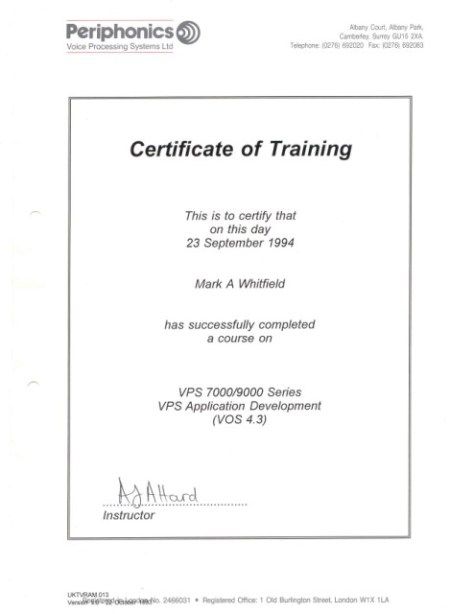
Periphonics certificate of training

HPE NonStop Tandem Programming Languages, a development timeline

HPE NonStop (formerly Tandem) has evolved through distinct architectural eras, each introducing specific programming languages and environments to maintain its legendary fault tolerance. 

1. The Tandem Stack Machine Era (1974–1990)

This era focused on the proprietary 16-bit stack-based architecture (TNS), where software was designed to “fail-fast” and operate in process pairs. 

  • Nov 1974: Tandem Computers founded by Jimmy Treybig.
  • May 1976: TAL (Transaction Application Language) launched with the first Tandem/16 (NonStop I) system. It was the only language available at launch, derived from HP 3000’s SPL.
  • Late 1970s: COBOL74FORTRAN, and MUMPS were added to support business and scientific applications.
  • 1981: NonStop II introduced support for 32-bit addressing, enabling larger application memory.
  • 1983: SCOBOL (Screen COBOL) emerged alongside the Pathway transaction manager to handle terminal-based user interfaces and fault-tolerant logic.
  • 1986: NonStop SQL released as the first fault-tolerant relational database language.
  • 1987: C was introduced to the platform.
  • 1989: Integrity S2 line launched using MIPS processors, introducing a variant of Unix called NonStop UX

2. The MIPS RISC / Himalaya Era (1991–2004)

As Tandem migrated to MIPS processors (TNS/R), it introduced a Unix-like personality to attract modern developers while maintaining its legacy Guardian environment. 

  • 1991: Cyclone/R launched. Most software still ran in TNS stack mode using an “Accelerator” tool to translate code to MIPS instructions.
  • 1993: Himalaya K-Series released with native-mode compilers for C and COBOL to leverage MIPS performance.
  • 1994/1995: Open System Services (OSS) introduced a POSIX-compliant environment, enabling C++ and standard Unix utilities.
  • 1995: Java was first supported on the platform.
  • 1997: Compaq acquired Tandem; ServerNet became the standard interconnect.
  • Late 1990s: Support for scripting languages like PerlPython, and PHP began appearing in the OSS environment.

3. The HP Integrity Itanium Era (2005–2013)

Following the HP merger, the architecture moved to Intel Itanium (TNS/E), branded as HP Integrity NonStop

  • 2005: NonStop i introduced. Compilers for CC++, and Java were updated for the Itanium architecture.
  • 2000s: pTAL (Portable TAL) became the standard for system-level programming to bridge legacy TAL code to modern RISC/Itanium architectures.
  • 2011: Enhanced support for modern web languages and frameworks within the OSS environment. 

4. The Modern x86 / NonStop X Era (2014–Present)

HPE migrated the entire stack to standard Intel x86-64 processors (TNS/X) while retaining binary compatibility for legacy applications. 

  • 2014: NonStop X launched. All languages (COBOL, C, C++, Java) were migrated to target x86-64.
  • 2015: Transition to Hewlett Packard Enterprise (HPE) branding.
  • Recent Years: Integration of modern open-source dev-ops tools and languages, including JavaScript (Node.js)Python 3Go, and Samba via the HPE NonStop OSS environment. 

HPE NonStop (formerly Tandem) programming has evolved from proprietary languages designed for fault-tolerant, transaction-oriented processing (TAL, COBOL85) to supporting open-source languages (Java, C++, Python, PHP) on modern x86-64 hardware. The ecosystem spans from the initial Guardian OS to modern J-series and L-series OS, supporting TNS, TNS/R, TNS/E, and TNS/X architectures. 

Key Programming Languages & OS Timeline

  • 1970s–1980s (Tandem Guardian): Core development centered on TAL (Transaction Application Language) (system programming), COBOL85 (business logic), and TACL (Tandem Advanced Command Language) (command shell scripting).
  • 1990s (Guardian 90 / NonStop UX): Introduction of C and C++ for more flexible application development, alongside Pascal and FORTRAN.
  • 2000s (H-Series / J-Series – Itanium): Shift towards Java and enhanced support for C/C++ in the Pathway server environment.
  • 2010s–Present (J-Series / L-Series – x86-64): Modern NonStop systems, particularly on x86-64, expanded to include scripting languages like PerlPHP, and Python within the Open System Services (OSS) environment.
  • pTAL (Portable TAL): Introduced to bridge native TAL to newer, more portable processor architectures. 

Operating System & Architecture Evolution

  • Guardian (TNS): The foundational OS, relying on Tandem’s native stack, with TAL as the primary low-level language.
  • OSS (Open System Services): Introduced to bring POSIX-compliant, Unix-like functionality to NonStop, enabling easier porting of C/C++ and open-source applications.
  • Modern OS (J-series/L-series): Supports both Guardian (native) and OSS environments, allowing for a hybrid approach where traditional transaction processing (COBOL/TAL) mixes with modern web services (Java/Python).

HPE NonStop Pathway (now often part of NonStop TS/MP) – Detailed Timeline

HPE NonStop Pathway (now often part of NonStop TS/MP) has a legacy spanning nearly five decades, evolving from a terminal management system into a sophisticated middleware for high-scale, fault-tolerant Online Transaction Processing (OLTP)

Comprehensive Evolution Timeline

  • 1976: Genesis (Tandem Computers)
    The HP NonStop platform was originally introduced by Tandem Computers Inc. as the first fault-tolerant commercial computer. Pathway was soon developed to manage the distribution of transaction requests across multiple server processes.
  • 1980s: The Classic Pathway Era
    Pathway became the standard for “Screen COBOL” applications. It introduced the PATHMON process to monitor and manage serverclasses, ensuring that if one process failed, another would immediately take its place.
  • 1997: Compaq Acquisition
    Compaq acquired Tandem, integrating the NonStop technology into its enterprise portfolio. During this time, Pathway began adapting to newer networking protocols and client-server architectures.
  • 2002: Hewlett-Packard (HP) Acquisition
    HP merged with Compaq, and the platform was rebranded as HP NonStop. Pathway evolved into NonStop TS/MP (Transaction Services/Massive Parallelism), allowing for even greater scalability across massive clusters of processors.
  • 2014–2015: The x86 Revolution
    HP announced the NonStop X architecture, moving the platform from Itanium processors to standard Intel x86 hardware. Pathway (TS/MP) was optimized to run on this new architecture, providing the same high availability with modern hardware performance.
  • 2015–Present: HPE and Modern Middleware
    Following the split of HP, Hewlett Packard Enterprise (HPE) continued developing Pathway. Modern versions (like NonStop TS/MP 2.8) support advanced features like:
    • Dynamic Server Processes: Automatically scaling server instances based on load.
    • Heterogeneous Interoperability: Allowing TUXEDO or Java clients to access Pathway servers.
    • Virtualization: Deployment via HPE NonStop Virtual Enterprise (vNS). 

Core Components Over Time

  • PATHMON: The “manager” process that monitors all objects in the environment.
  • PATHCOM: The command-line interface used to configure and start Pathway objects.
  • Serverclasses: Groups of identical server processes that distribute transaction load for fault tolerance. 

HPE NonStop Pathway (now often part of NonStop TS/MP) – Detailed Timeline