

The history of DevOps is a transition from siloed development and operations teams toward a unified culture of automation and collaboration.
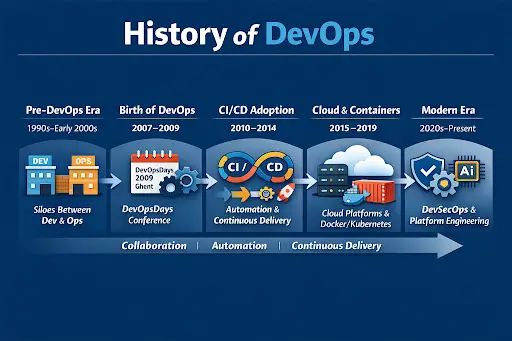
Pre-DevOps & Foundations (2001–2008)
- 2001: The Agile Manifesto is published, laying the groundwork for iterative software development and cross-functional teamwork.
- 2006: Amazon Web Services (AWS) launches, providing the cloud infrastructure necessary for rapid, automated deployments.
- 2007: Belgian consultant Patrick Debois begins investigating ways to bridge the gap between development and operations while working on a data centre migration project.
- 2008: At the Agile conference in Toronto, Andrew Shafer and Patrick Debois meet and discuss “Agile Infrastructure,” marking the conceptual start of the movement.
The Emergence of DevOps (2009–2014)
- 2009: John Allspaw and Paul Hammond give the legendary talk “10+ Deploys Per Day: Dev and Ops Cooperation at Flickr” at the Velocity Conference.
- 2009: Patrick Debois organises the first DevOpsDays in Ghent, Belgium, and coins the term “DevOps“.
- 2011: Analyst firm Gartner officially predicts DevOps will evolve from a niche concept to a mainstream strategy.
- 2013: The book The Phoenix Project is published, popularising DevOps principles through a fictional narrative of a company’s digital transformation.
- 2013: Docker is released, revolutionising the industry by making containerization accessible and consistent across environments.
- 2014: The first State of DevOps Report is published by Puppet, providing data-driven evidence of DevOps’ impact on performance.
Mainstream Adoption & Cloud-Native (2015–2019)
- 2015: Google releases Kubernetes as an open-source project, establishing the standard for container orchestration.
- 2015: Major cloud providers launch managed container services, such as Google Kubernetes Engine (GKE).
- 2017: Security begins “shifting left,” leading to the formalisation of DevSecOps within development pipelines.
- 2018: The book Accelerate is published, detailing the science behind high-performing DevOps organisations.
- 2019: DevOpsDays celebrates its 10th anniversary with events in over 20 countries, signalling global maturity.
The AI & Platform Era (2020–2026)
- 2020: The COVID-19 pandemic accelerates remote work and digital transformation, making DevOps practices essential for enterprise survival.
- 2023: Generative AI begins to be integrated into CI/CD pipelines for automated code generation, testing, and anomaly detection.
- 2024: The focus shifts to Platform Engineering, aiming to reduce developer cognitive load through Internal Developer Platforms (IDPs).
- 2025: AIOps (Artificial Intelligence for IT Operations) becomes standard for predictive analytics and self-healing infrastructure.
- 2026: DevOps continues to evolve with a focus on zero-CVE container images and high-demand roles for engineers who can manage AI-driven workflows.
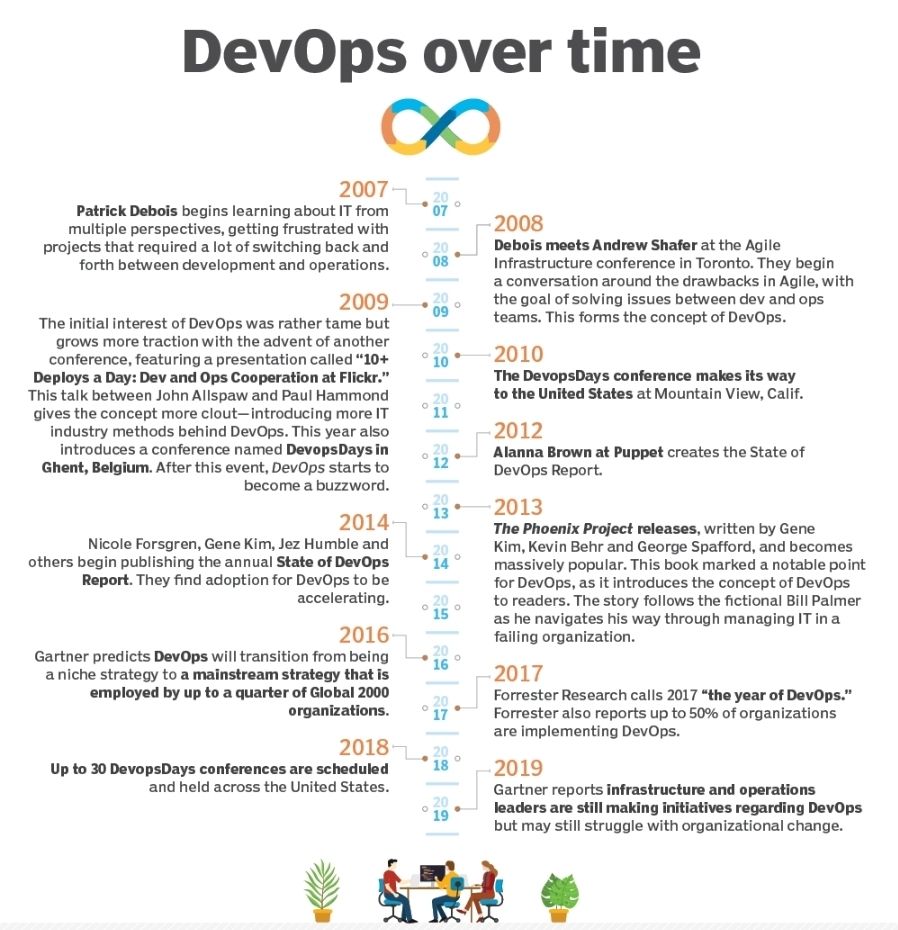
DevOps Development Timeline History Overview

 PROject Templates