

The history of cloud computing evolved from 1950s time-sharing concepts to today’s AI-integrated hyperscale ecosystems. While John McCarthy and J.C.R. Licklider envisioned computing as a global utility in the 1960s, the modern era truly began with the 1999 launch of Salesforce and the 2006 debut of Amazon Web Services (AWS).
Foundational Era (1950s – 1980s)
- 1955: John McCarthy introduces the theory of sharing computing time among a group of users.
- 1961: McCarthy proposes that computing will one day be sold as a public utility, similar to water or electricity.
- 1967: IBM develops the first operating system that allows multiple users to timeshare a single resource.
- 1969: ARPANET (Advanced Research Projects Agency Network) is launched, serving as the precursor to the modern internet.
- 1972: IBM releases the first version of its Virtual Machine (VM) operating system.
- 1977: The cloud symbol is first used in original ARPANET diagrams to represent networks of computing equipment.
The Rise of the Modern Cloud (1990s – 2009)
- 1996: The term “cloud computing” appears in an internal Compaq business plan.
- 1997: Professor Ramnath Chellappa defines cloud computing as a “computing paradigm where the boundaries of computing will be determined by economic rationale”.
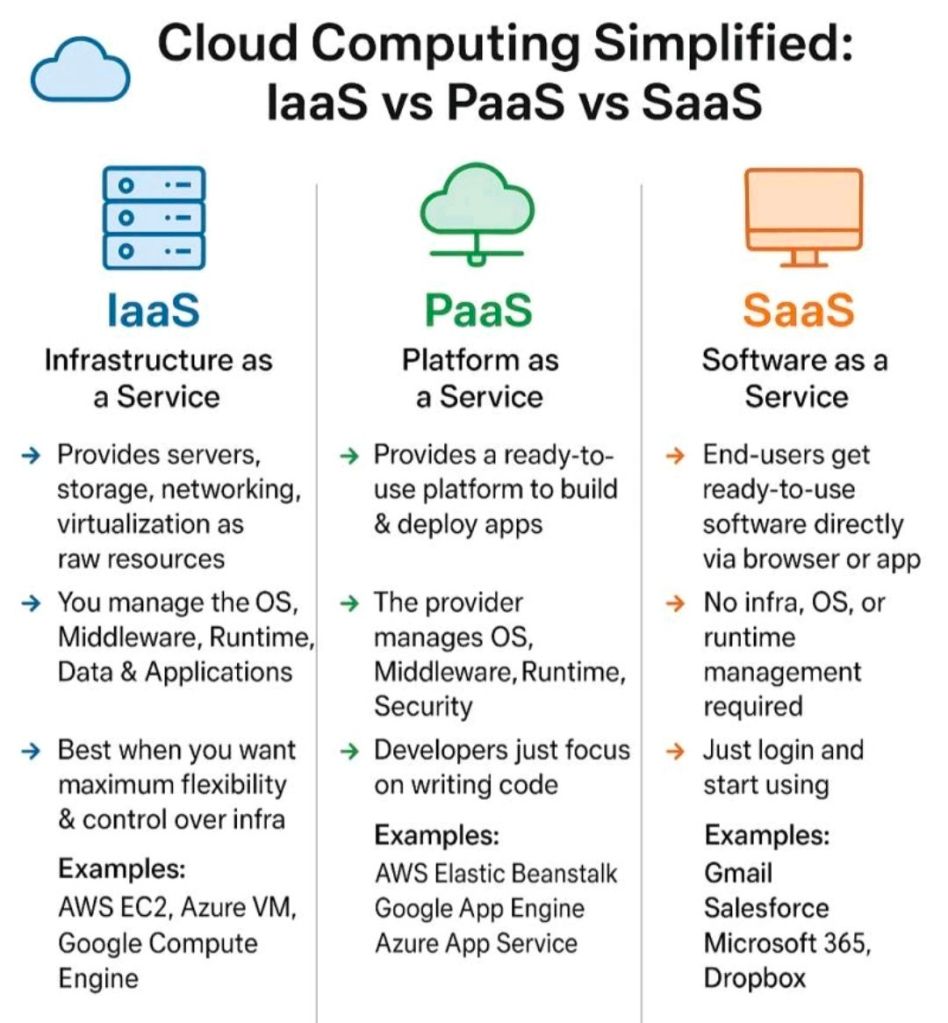
- 1999: Salesforce.com launches, becoming the first company to offer business applications over the internet, pioneering SaaS.
- 2002: Amazon Web Services (AWS) launches as a suite of web-accessible tools for developers.
- 2006: AWS releases Elastic Compute Cloud (EC2) and Simple Storage Service (S3), marking the birth of modern IaaS.
- 2007: Netflix begins its transition to a video-streaming service using cloud infrastructure.
- 2008: Google releases Google App Engine, a platform for developing and hosting web applications in its data centres.
- 2009: Google Apps (now G Suite) launches, bringing browser-based enterprise applications to the mainstream.
Expansion & Specialisation (2010 – 2019)
- 2010: Microsoft officially releases Azure.
- 2010: NASA and Rackspace initiate OpenStack, an open-source project for cloud software.
- 2011: Apple launches iCloud, popularising consumer cloud storage.
- 2012: Oracle enters the market with Oracle Cloud.
- 2013: Docker introduces open-source container software, revolutionising application portability.
- 2014: Google launches Kubernetes for container orchestration, and AWS introduces Lambda, pioneering serverless computing.
- 2019: Microsoft Azure introduces Azure Arc, enabling services to run across various on-premises and cloud environments.
The AI & Edge Era (2020 – Present)
- 2020: The COVID-19 pandemic accelerates cloud adoption for remote work and education.
- 2022-2024: Cloud providers integrate GenAI and Machine Learning into core services, such as Microsoft’s alliance with OpenAI.
- 2025: Quantum-as-a-Service gains traction, with IBM providing cloud access to systems with over 1,000 qubits.
- 2026: Global spending on cloud services (SaaS, PaaS, and IaaS) is forecast to reach approximately $738 billion.
History of Cloud Computing timeline by year
 PROject Templates