

The sp/ARCHITECT-BANK software suite (which later evolved into the CONNEX Advantage banking solution) was a pioneering electronic banking and high-availability funds-transfer platform.
Originally engineered by the British software house The Software Partnership (TSP), its operational history spans multiple corporate acquisitions and distinct hardware/software shifts across the Tandem / HPE NonStop mainframe eras.
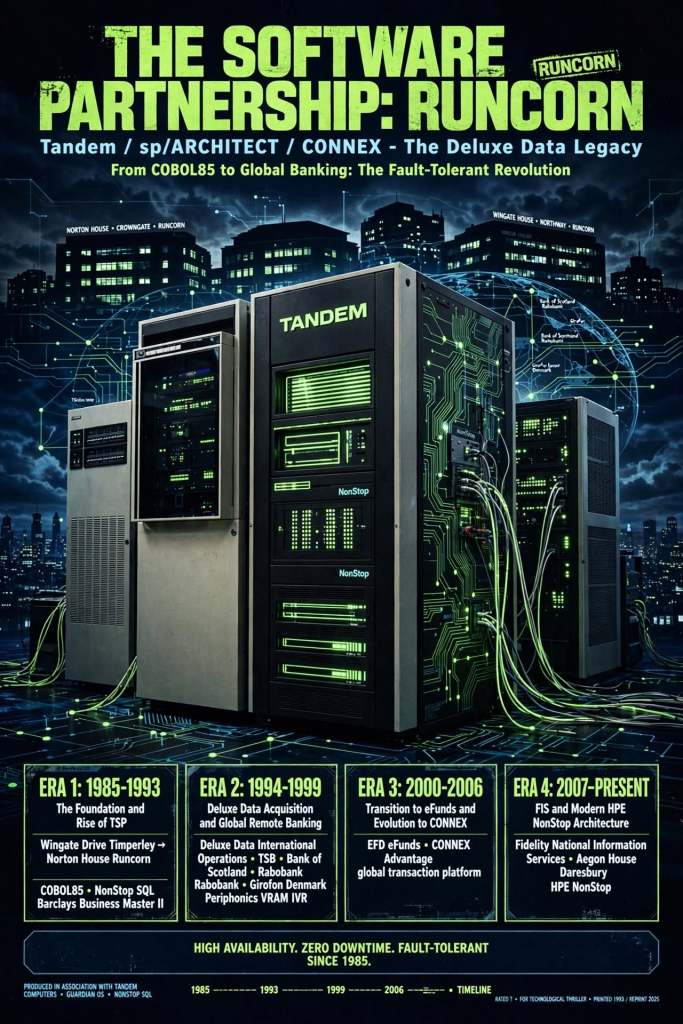
A detailed historical and technical timeline, organized by era and year, outlines this evolution:
Era 1: The Foundation and Rise of TSP (1985–1993)
This era is characterized by the initial development of custom online banking architectures using terminal-based and early desktop interfaces hosted on fault-tolerant Tandem platforms.
- 1985: The Software Partnership (TSP) is co-founded by Nigel Walsh. The office begins its lifespan at Wingate Drive in Timperley before relocating to Norton House in Crowngate, Runcorn, Cheshire.
- 1986–1989: Development focuses heavily on terminal-to-mainframe applications. Initial conceptual designs for standard financial electronic messaging modules are drafted.
- 1990: The development team expands. Systematic framework engineering begins for sp/ARCHITECT-BANK, mapping out high-volume, fault-tolerant electronic home-banking services natively on Tandem NonStop mainframe computers.
- 1991: Engineers utilize COBOL85 and NonStop SQL to write highly specialized high-performance back-ends. Work begins on modular integration for major high-street systems, notably creating functional back-end modules for the Barclays Business Master II (BBM II) deployment.
- 1992: TSP expands out of Norton House and opens new headquarters at Wingate House on Northway, Runcorn.
- 1993: Dedicated batch host interface development, testing, and system logic designs are integrated into the primary sp/ARCHITECT standard product release. Concurrently, engineering expands to build the sp/ARCHITECT-BANK Billing System utilized for automated commercial client accounts.
Era 2: Deluxe Data Acquisition and Global Remote Banking (1994–1999)
The push for early remote corporate desktop banking and international scalability triggers American corporate buyouts.
- 1994: Deluxe Electronic Payment Systems (a branch of Deluxe Corporation, a massive US check printer and debit processor) acquires TSP. The Runcorn facilities are rebranded as Deluxe Data International Operations.
- 1994 (Technical): The completed sp/ARCHITECT-BANK framework is commercially rolled out to major banking environments. This enables early, pre-widespread-internet desktop corporate banking for entities like TSB and the Bank of Scotland to handle inter-account transfers securely.
- 1995: 24-hour critical operational support is established across European banking networks. The sp/ARCHITECT architecture is adapted for international environments, including Rabobank in the Netherlands.
- 1996: Developers create an integrated voice, menu-driven, touch-tone interactive module for Girofon (Denmark). The software interfaces Tandem NonStop mainframes with Periphonics VRAM Interactive Voice Response (IVR) hardware devices.
- 1997–1998: The core software architecture is progressively modified to prepare for the massive transaction demands of modern ATMs, point-of-sale (POS) systems, and impending debit card clearing volumes.
Era 3: Transition to eFunds and Evolution to CONNEX (2000–2006)
A shift towards generic electronic transaction processing platforms results in corporate realignment and standard product evolution.
- 2000: Deluxe Data re-emerges into a combined corporate entity known as EFD eFunds (Electronic Funds Danbury).
- 2001–2003: The legacy sp/ARCHITECT codebase begins its structural integration pathway with mainstream US electronic payment technologies.
- 2004: The underlying technical components of sp/ARCHITECT-BANK are systematically integrated, scaled, and evolved directly into the global CONNEX Advantage software solution suite. This shifts the technology into a globally standardized card-management and transaction-switching platform.
- 2005–2006: Migration of legacy customer portfolios over to standard CONNEX platforms running on newer generation HPE NonStop hardware frameworks.
Era 4: FIS and Modern HPE NonStop Architecture (2007–Present)
Integration into mega-scale fintech operations and modern high-availability infrastructure.
- 2007: Fidelity National Information Services (FIS) acquires eFunds. The technical hub moves out of Wingate House in Runcorn into Aegon House in Daresbury, Warrington.
- 2008–Present: The legacy established by the original Runcorn development team persists inside FIS’s massive enterprise payments division. The original core philosophies of sp/ARCHITECT and the subsequent CONNEX lineages are fully sustained on ultra-modern, fault-tolerant, multi-core HPE NonStop systems, serving continuous global banking, switching, and ATM transactions worldwide.

