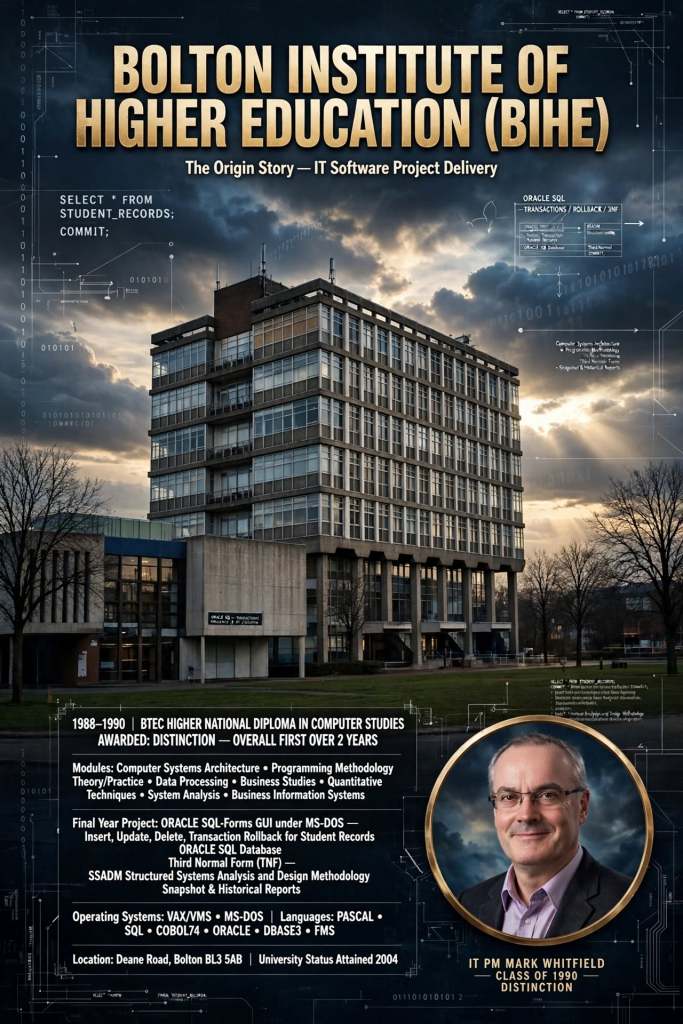
Mark Whitfield, a Senior IT Project Manager (SC cleared), attended the Bolton Institute of Higher Education (BIHE) from 1988 to 1990, where he completed a full-time, 2-year Higher National Diploma (HND) in Computer Studies and graduated overall first in his class with a Distinction.

The detailed history, structure, qualification breakdown, and module purpose of Mark Whitfield’s time at BIHE are outlined below.
📍 Location Account
- Institution Name: Bolton Institute of Higher Education ( BIHE ), now University of Greater Manchester from 2024
- Address: Deane Road, Bolton, Lancashire, UK, BL3 5AB
- Learning Environment: Studies were conducted on the main campus at the old BIHE building in Bolton town centre.
🏛️ BIHE History Overview
The institution where Whitfield studied has a long history of institutional evolution:
- Origins: Founded originally as the Bolton Mechanics’ Institute in 1824–1825.
- BIHE Era: Formed later through mergers, operating as the Bolton Institute of Higher Education during Whitfield’s attendance (1988–1990).
- Transition to University: BIHE was granted taught degree-awarding powers in 1990/1992 and achieved full university status in 2004/2005, becoming the University of Bolton, then recently (as of 2024), University of Greater Manchester.
🎓 The HND Qualification Explained
A Higher National Diploma (HND) is a specialized Level 5 vocational qualification in the UK.
- Equivalency: It is equivalent to completing the first two years of a university bachelor’s degree.
- Purpose: It focuses on delivering industry-specific, practical, and hands-on technical skills rather than purely theoretical academic knowledge.
- Timeline: The qualification was originally introduced in England and Wales in 1920 to bolster industrial and advanced technical training.
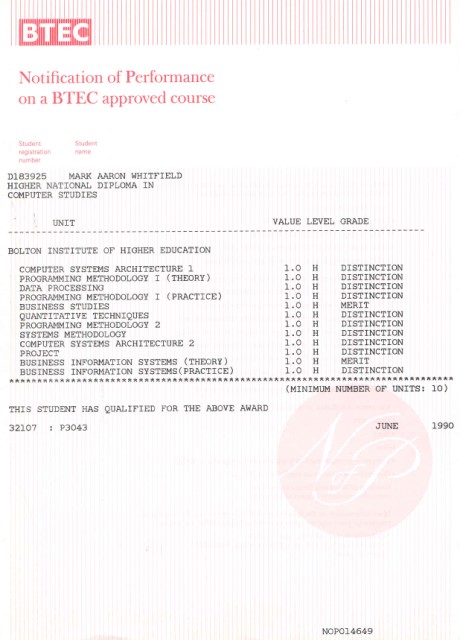
🏆 Pass Achieved
- Grade: Distinction
- Rank: Overall First place over the two years of the course.
Certificates:


📚 Course Modules and Academic Purpose
The 2-year full-time curriculum was intentionally structured to merge technical software engineering with commercial business acumen:
- Computer Systems Architecture: Focused on understanding hardware frameworks, machine-level operations, and system physics.
- Programming Methodology Theory / Practice: Taught rigorous code structure, logical execution, syntax standards, and program optimization.
- Data Processing: Explored the mechanics of data storage, lifecycle tracking, file inputs/outputs, and basic records management.
- System Analysis: Provided foundational blueprints for reviewing business requirements, mapping workflows, and designing end-to-end software frameworks.
- Business Information Systems Theory / Practice: Covered how modern computing applications are integrated to support daily corporate operations.
- Business Studies: Taught standard corporate economics, organizational management, and operational workflows to ensure technical projects align with company goals.
- Quantitative Techniques: Focused on mathematical modeling, statistics, and numeric analysis used in computing problem-solving.
💻 Final Year Project Purpose

Project Overview:
As part of the Programming Methodology module, Mark designed a functional system to manage student administration at BIHE.
- Tech Stack: An ORACLE SQL database hosted locally on an MS-DOS operating system, utilizing an ORACLE SQL-forms Graphical User Interface (GUI).
- Functionality: Allowed users to insert, update, delete, and execute transaction rollbacks for student demographics, course assignments, and exam results.
- Methodology: Designed in accordance with Third Normal Form (3NF) relational database design methodology to eradicate redundant, repeating data and generate historical reporting.

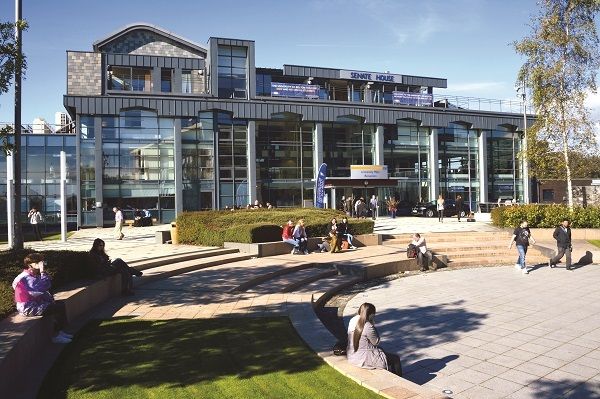

HND Computer Studies, 1988 – 1990, Course Structure over 2 years
The course traditionally follows a two-year full-time or three-year part-time structure.
Year 1: Foundations (HE4 Level)
The first year focuses on establishing core technical and business knowledge. In many versions of the Bolton curriculum, Year 1 is common across several computing programmes to allow for flexible progression.
- Core Modules:
- Introduction to Programming: Developing fundamental coding logic.
- Computer Platforms & Systems Architecture: Understanding the hardware and software environments.
- Information Systems & Databases: The basics of data management.
- Website Production & Networking Fundamentals: Introduction to web technologies and connectivity.
- Quantitative Techniques & Business Studies: Integrating mathematical and commercial contexts.
Year 2: Specialisation (HE5 Level)
The second year shifts toward advanced application, systems analysis, and professional practice.
- Advanced Modules:
- Systems Analysis & Design: Producing system requirements and user interface specifications.
- Programming Methodology: Moving into more complex application development.
- Business Information Systems: Exploring how IT supports organizational requirements.
- Database Design: Implementing industry-standard database packages.
- Final Year Project: A major 20-credit core project where students investigate a specific field and apply their cumulative skills to a real-world scenario.
Progression and Modern Standards
- Academic Standing: Completion of the HND is equivalent to the first two years of a Bachelor’s degree (Level 5).
- Degree Top-Up: Successful HND graduates can typically proceed directly into the final year (Level 6) of the BSc (Hons) Computer Science or BSc (Hons) Computing at Bolton.
- Modern HTQs: Current versions of the course, such as the HND Computing for England (HTQ), now integrate modern fields like Artificial Intelligence, Cloud Computing, and VR technologies.
University of Greater Manchester, University of Bolton, Bolton Institute of Higher Education ( BIHE ) group :
LinkedIn Group: https://www.linkedin.com/groups/51224