

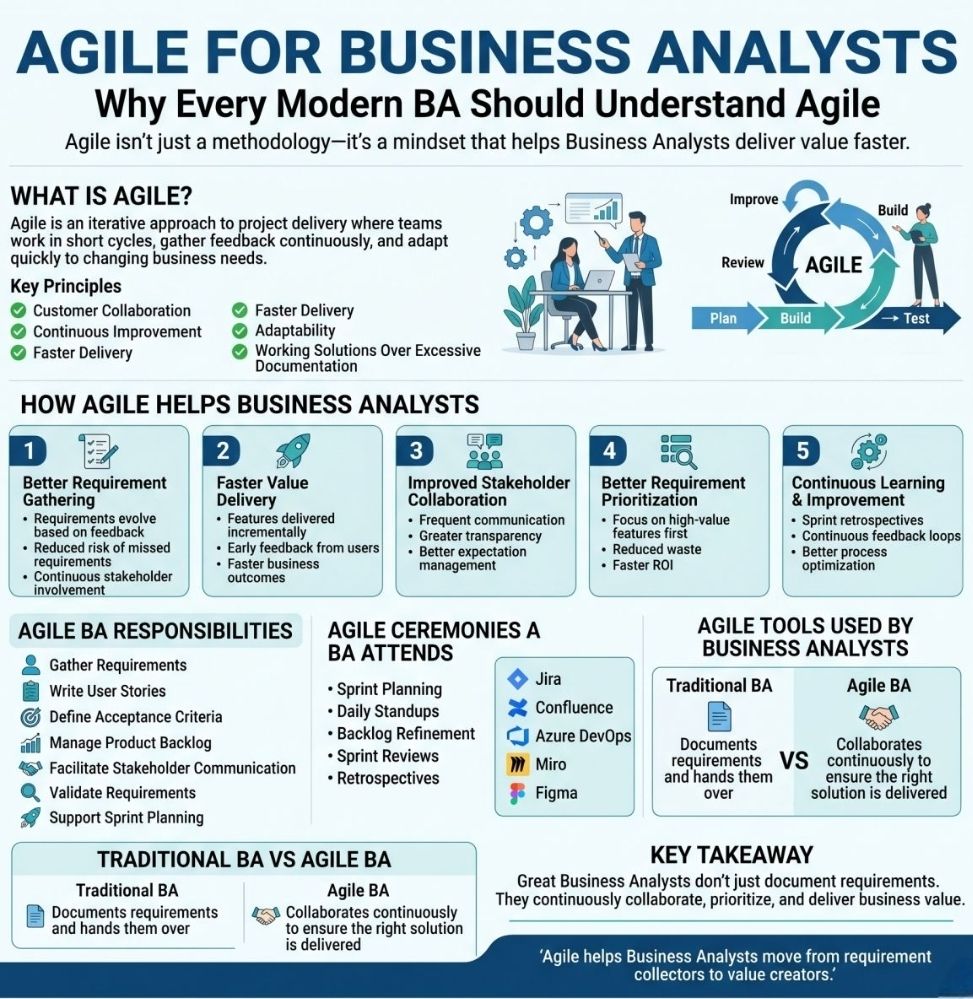
In an Agile environment, a Business Analyst (BA)acts as the crucial bridge between business stakeholders and the technical team. Rather than gathering all requirements upfront, Agile BAs focus on continuous analysis, delivering value in small increments, and writing lightweight user stories that adapt as the product evolves.
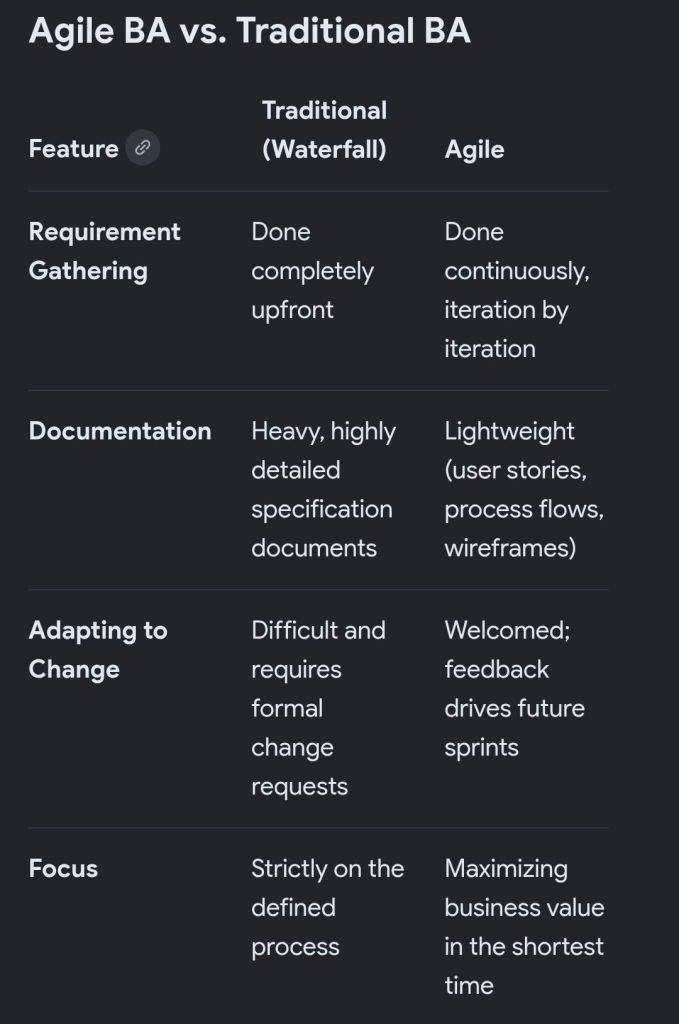
Transitioning from traditional (Waterfall) analysis to an Agile framework requires a fundamental shift in how requirements are handled, documented, and delivered.
The Core Shifts in an Agile BA Role
- Continuous Discovery: Instead of producing a massive Requirements Document at the start, BAs analyze and refine requirements just-in-time and just-enough to keep the development team moving.
- User Stories over BRDs: Traditional Business Requirements Documents (BRDs) are replaced with collaborative user stories and acceptance criteria.
- Value-Driven Prioritization: The BA continuously helps the Product Owner (or acts as the Product Owner proxy) rank the Product Backlog so that the highest-value features are built first.
- Shared Understanding: The focus is on face-to-face communication, workshops, and visual modeling (like wireframes) to ensure developers fully grasp what needs to be built.
Key Responsibilities
Agile BAs operate across several domains throughout the sprint lifecycle:
- Backlog Refinement: Collaborating with stakeholders to break down large, complex requirements into smaller, manageable chunks (Epics to User Stories).
- Definition of Ready (DoR): Ensuring that user stories are clear, testable, and have defined acceptance criteria before they are pulled into an active sprint.
- Sprint Support: Answering questions from the development team in real-time, clarifying business rules, and helping to remove blockers.
- Acceptance Testing: Assisting Quality Assurance (QA) teams or business users to validate that the delivered software works as intended and solves the underlying business problem.
Common Frameworks for Agile BAs
- Scrum: Working alongside the Scrum Master, Product Owner, and Developers in short iterations (sprints), typically lasting 2 to 4 weeks.
- Kanban: Managing a continuous flow of analysis work, prioritizing items on a visual board as development capacity allows.
- AgileBA: A specific certification and framework designed by the Agile Business Consortium that provides BAs with practical tools for working in Agile settings.
Recommended Resources for Skill Building
To deepen your expertise in Agile business analysis, explore these highly regarded methodologies and guides:
- Use the AgileBA Certification guide to understand official best practices.
- Read the IIBA Agile Extension to the BABOK Guide for authoritative frameworks.
- Review Bridging the Gap for practical, real-world implementation strategies.


