BRD vs FRD, Business Requirements vs Functional Requirements

BRD vs FRD, Business Requirements vs Functional Requirements

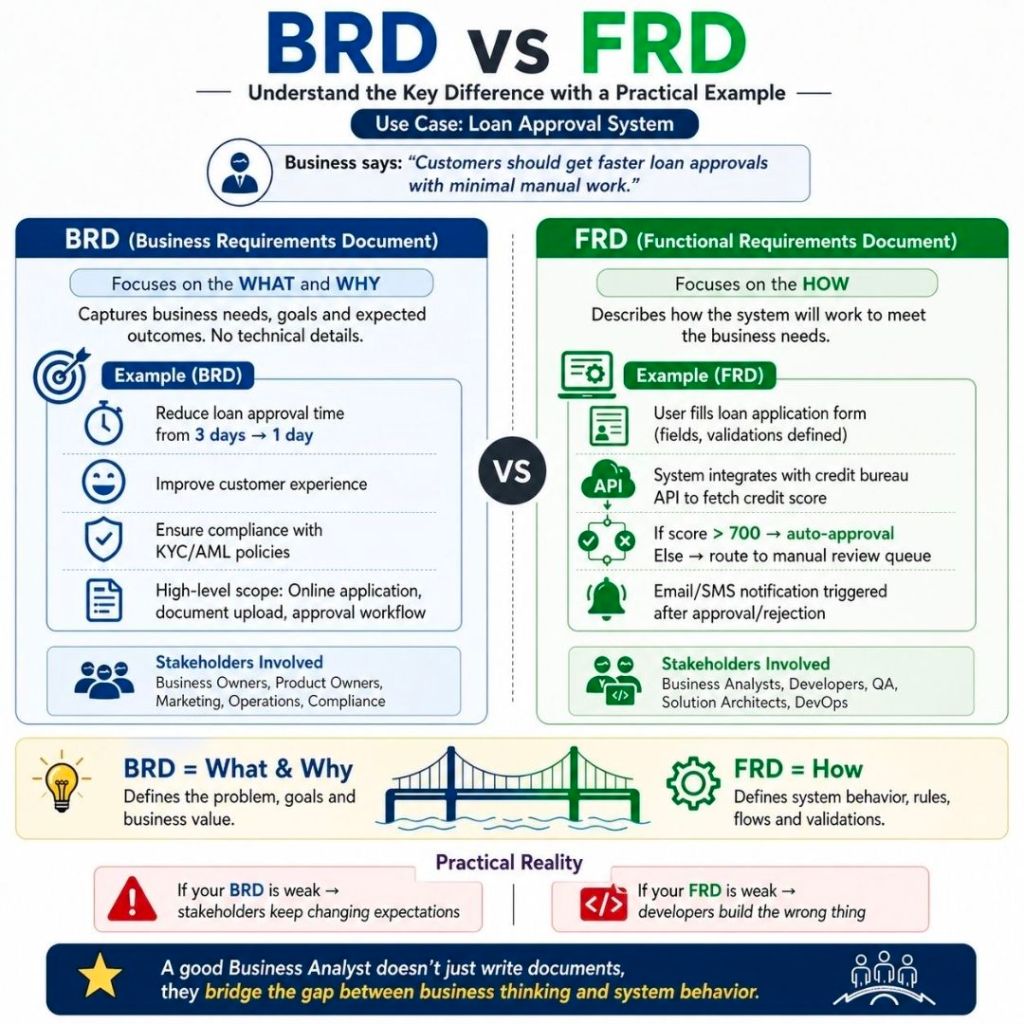
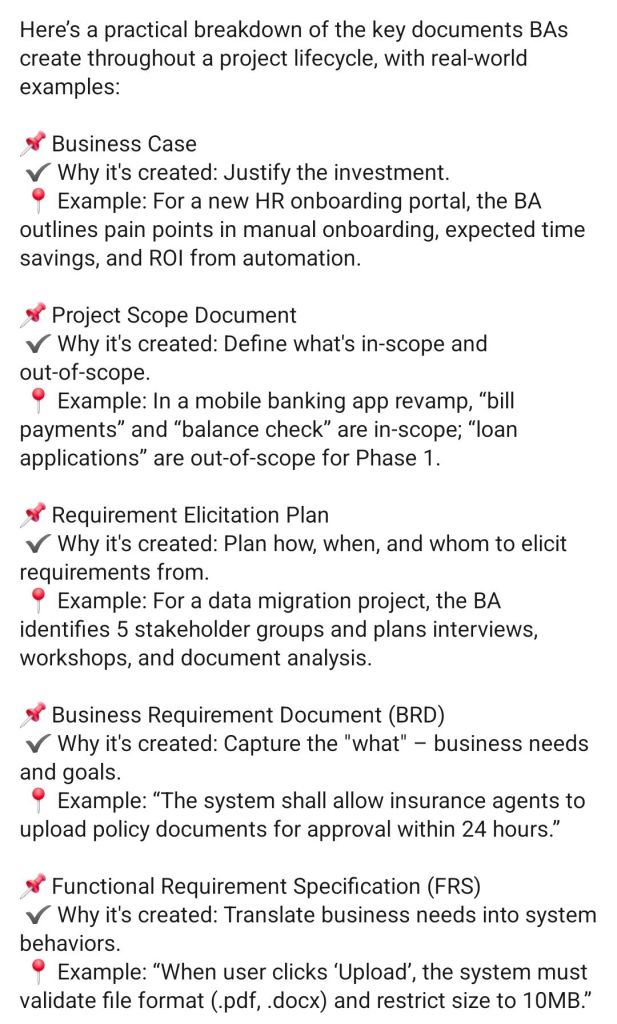
The primary difference between a Business Requirement Document (BRD) and a Functional Requirement Document (FRD) is that the BRD focuses on “why” a project is needed (business objectives), while the FRD details “how” the system will work to meet those needs. The BRD serves stakeholders and leadership, whereas the FRD guides developers and technical teams.

Key Differences at a Glance:

  • BRD (Business Requirements Document):
    • Goal: Defines business objectives, goals, and high-level needs.
    • Focus: “What” the business wants to achieve.
    • Audience: Stakeholders, Project Sponsors, Project Managers.
    • Key Content: Business problem, scope, ROI, high-level project goals.
  • FRD (Functional Requirements Document):
    • Goal: Translates business needs into detailed technical functionalities.
    • Focus: “How” the system will perform to meet requirements.
    • Audience: Developers, Testers, Technical Team, Business Analysts.
    • Key Content: Feature descriptions, user interactions, system workflows, data requirements, UI mockups.

How They Work Together:
The BRD is created first to get approval for the project, while the FRD is developed based on the approved BRD. The FRD ensures the project is actionable, testable, and feasible. In Agile, these are often combined into smaller artifacts like User Stories.

Unknown's avatar

Author: Mark Whitfield

Welcome to my site! After graduating in Computing in 1990, I accepted a position as a programmer at a Runcorn based software house specialising in electronic banking software, namely sp/ARCHITECT-BANK on Tandem Computers (now HPE NonStop). This was before the internet became more prevalent and so the notion of enabling desktop access to company accounts for inter-account transfers and book keeping was still quite a cutting edge idea (and smartphones only ever hinted at in Space 1999). The company was called The Software Partnership (which was taken over by Deluxe Data in 1994). I spent 5 years in Runcorn developing code for SP/ARCHITECT for various banks like TSB, Bank of Scotland, Rabobank and Girofon (Denmark) to name but a few. I then moved onto a software house in Salford Quays for further bank facing projects. After a further 23 years in the IT industry and now a Senior IT Project Manager (both Agile and Waterfall delivery), I thought I would echo out my Career Profile in this corner of the internet for quick and easy access.

Leave a comment