

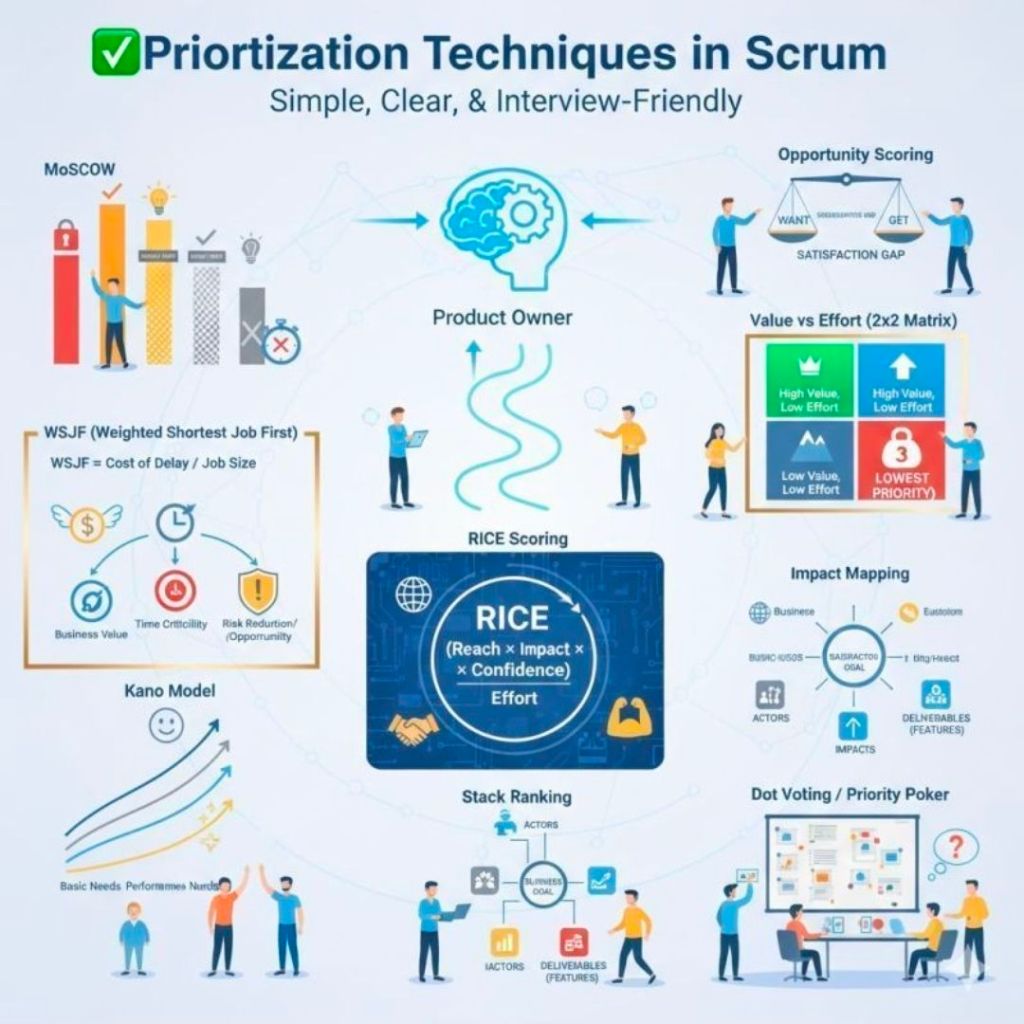
Prioritization in AgileScrum is the systematic process of ordering Product Backlog items to maximize value delivery. These techniques are generally categorized by their primary focus: customer satisfaction, business value and economics, or collaborative consensus.
Category 1: Customer-Centric Frameworks
These methods prioritize features based on how they impact the end-user’s experience and satisfaction.
- Kano Model: Categorizes features into three main types: Basic Needs (expected essentials), Performance Features (linear satisfaction), and Excitement Needs (unexpected “delighters”).
- User Story Mapping: Visualizes the entire user journey to identify the most critical paths and “skeletal” features needed for a Minimum Viable Product (MVP).
- Opportunity Scoring: Uses customer research to find gaps where importance is high but current satisfaction is low, identifying high-potential opportunities.
Category 2: Economic & Quantitative Models
These data-driven techniques use formulas to balance value against implementation costs or risks.
- Weighted Shortest Job First (WSJF): Prioritizes tasks by dividing the Cost of Delay (value, urgency, and risk reduction) by Job Size (effort). The goal is to deliver the most value in the shortest time.
- RICE Scoring: Calculates a score based on Reach (number of users), Impact, Confidence (certainty in estimates), and Effort.
- Cost of Delay (CoD): Measures the economic impact or potential revenue loss of not delivering a feature within a specific timeframe.
Category 3: Stakeholder & Team-Based Consensus
These collaborative methods are used to reach agreement among diverse stakeholders or team members.
- MoSCoW Method: A qualitative technique that buckets items into Must-Have, Should-Have, Could-Have, and Won’t-Have for a specific release cycle.
- 100-Dollar Test: Participants are given a hypothetical $100 to “spend” on features, revealing what they value most through resource allocation.
- Priority Poker: A gamified, collaborative approach where team members anonymously vote on an item’s priority level to remove bias and foster discussion.
Category 4: Structural & Visual Matrixes
These tools help teams visualize trade-offs, typically using 2×2 grids.
- Value vs. Effort Matrix: Plots tasks on two axes to identify Quick Wins (high value, low effort) and Major Projects (high value, high effort) while avoiding “thankless tasks”.
- Risk/Value Matrix: Balances potential business rewards against technical or project risks to decide which high-value but high-risk items to tackle early.
- Stack Ranking: A “forced ranking” method where every item has a unique, linear position (1 to N), preventing the “everything is high priority” trap.
Priorization Techniques in Agile Scrum


