

PRINCE2 (PRojects IN Controlled Environments) is a structured, process-based project management methodology focusing on organization, control, and business justification. Originating from UK government IT standards in the 1970s, it has evolved into a globally recognized, tailorable standard used in over 150 countries for projects across various industries.
PRINCE2 Project Management Summary
- Core Philosophy: Continued Business Justification (projects must make sense financially), Manage by Exception (delegating authority within limits), and Product-Based Planning.
- Seven Principles: Projects must have continued business justification, learn from experience, define roles and responsibilities, manage by stages, manage by exception, focus on products, and tailor to suit the project.
- Seven Processes: Starting a Project, Directing a Project, Initiating a Project, Controlling a Stage, Managing Product Delivery, Managing a Stage Boundary, and Closing a Project.
- Key Themes: Business Case, Organization, Quality, Plans, Risk, Change, and Progress.
- Main Benefits: Provides a common language, clear accountability, defined roles, and tailored, consistent documentation.
Detailed Historical Timeline (1975–2023+)
Era 1: The PROMPT Origins (1975–1988)
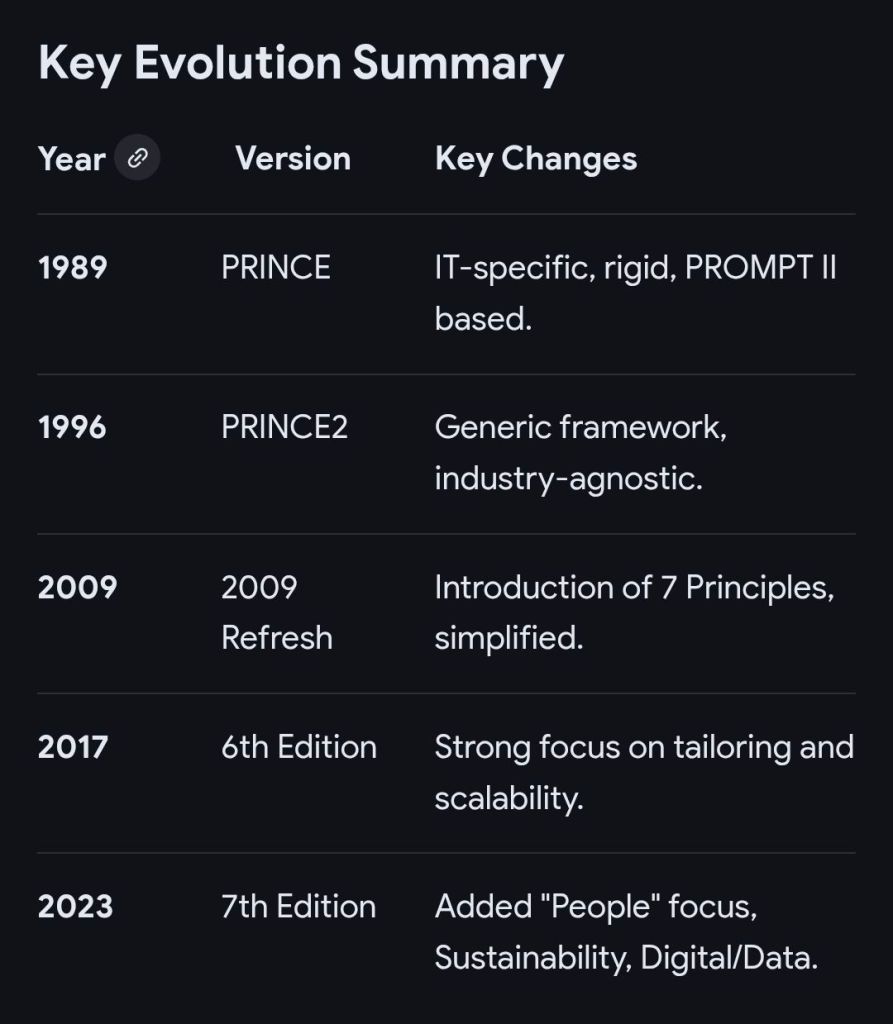
- 1975: Simpact Systems Ltd develops PROMPT (Project Resource Organisation Management and Planning Techniques) in response to IT projects running over time and budget. PROMPT II introduces a phased approach (Initiation, Specification, Design, Development, Installation, Operation).
Era 2: The PRINCE Birth (1989–1995)
- April 1989: The UK Central Computer and Telecommunications Agency (CCTA) adopts PROMPT II as the standard for IT projects, renaming it PRINCE (initially “PROMPT II IN the CCTA Environment”).
- 1990: PRINCE is released into the public domain and widely adopted by the private sector for non-IT projects, although it is perceived as too rigid for small projects.
Era 3: The Birth of PRINCE2 (1996–2008)
- 1996: PRINCE2 is published by the CCTA. It is rewritten for broader use (not just IT), removing jargon to become a generic project management framework.
- 1998: PRINCE2 begins undergoing revisions based on user feedback.
- 2000: The Office of Government Commerce (OGC) becomes the owner of PRINCE2.
- 2002: The international user community begins consultative updates to the method.
Era 4: The Modern Revision Era (2009–2022)
- 2009: PRINCE2: 2009 Refresh is released by the OGC. This major revision simplifies the method, makes it more customizable, and introduces the seven core principles.
- 2013: Ownership transfers from the UK Cabinet Office to AXELOS Ltd, a joint venture between the UK Government and Capita.
- 2017: PRINCE2 2017 Update is published, focusing on increased flexibility, scalability, and better tailoring guidance.
- 2018: PRINCE2 Agile is launched, bringing a governance layer to agile delivery methods like Scrum and Kanban.
- 2020: PRINCE2 2017 is renamed “PRINCE2 6th Edition”.
- 2021: PeopleCert becomes the sole owner of AXELOS and PRINCE2.
Era 5: The Current Era (2023–Present)
- September 2023: PRINCE2 7th Edition is released. The update introduces a “People” element, focusing on change management and team leadership, along with new guidance on Sustainability, Commercial, and Digital & Data management.
PRINCE2 (PRojects IN Controlled Environments) Overview and Timeline by Year

 PROject Templates