

The PMBOK (Project Management Body of Knowledge) Guide, published by the Project Management Institute (PMI), is the globally recognized standard for project management best practices. Its evolution reflects the shift from rigid, industrial-era scheduling to flexible, value-driven, and hybrid methodologies.
Summary of PMBOK Evolution
- 1980s (Origins): PMI sought to standardize knowledge, starting with a white paper in 1983 and the first “Body of Knowledge” document in 1987.
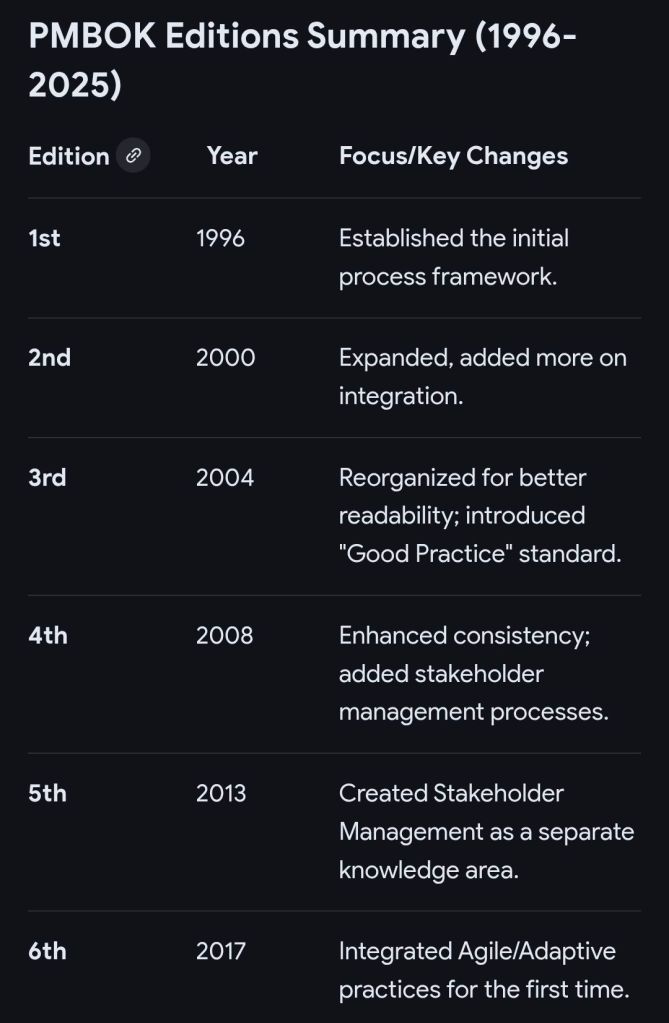
- 1996 (1st Edition): The first official PMBOK Guide was published, introducing a foundational process framework.
- 2000s (Expansion): The 2nd (2000) and 3rd (2004) editions expanded on integration and finalized the standard for project management.
- 2010s (Integration): The 4th (2008) and 5th (2012) editions added stakeholder management and aligned with enterprise needs. The 6th Edition (2017) formally bridged predictive (waterfall) and agile practices.
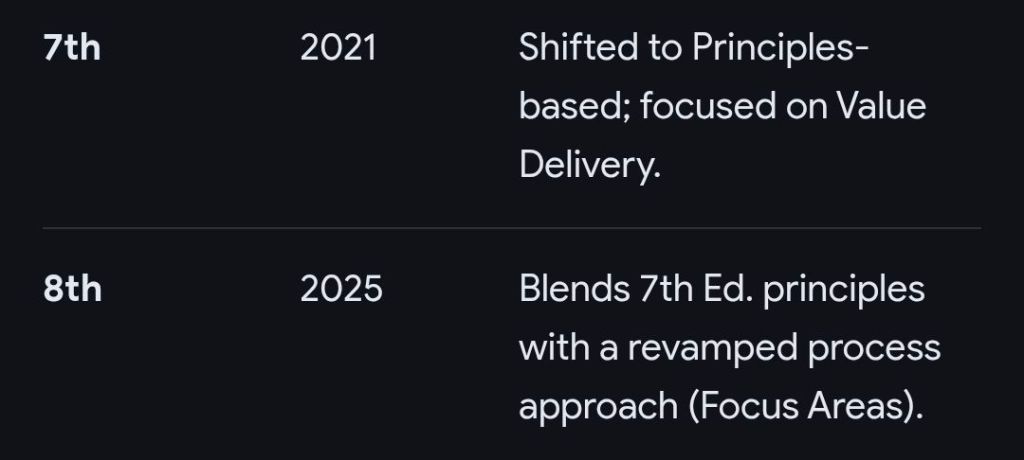
- 2020s (Transformation): The 7th Edition (2021) marked a massive shift from process-based to principle-based, focusing on project outcomes rather than just outputs. The 8th Edition (2025) reintroduces practical, tailored process guidance alongside principles.
Detailed Historical Timeline by Era and Year
Ancient Era to Pre-Modern (Before 1950s)
- 2570 BC: Completion of the Great Pyramid of Giza, requiring complex organization, planning, and control.
- 208 BC: Construction of the Great Wall of China, demonstrating massive, orchestrated labour management.
- 1917: Henry Gantt developed the Gantt chart, a foundational scheduling tool still used today.
The Foundation Era (1950s – 1960s)
- 1956: American Association of Cost Engineers (now AACE International) formed.
- 1957: Critical Path Method (CPM) invented by Dupont.
- 1958: Program Evaluation and Review Technique (PERT) developed by the U.S. Navy for the Polaris missile program.
- 1962: U.S. Dept of Defense mandated the Work Breakdown Structure (WBS) approach.
- 1969: Project Management Institute (PMI) founded to promote the profession and set standards.
The Formalization Era (1970s – 1980s)
- 1975: PROMPTII method created (later becoming PRINCE).
- 1984: Dr. Eliyahu M. Goldratt introduced the Theory of Constraints (TOC) in his book “The Goal”.
- 1986: Scrum named as a project management style.
- 1987: First PMBOK Guide published by PMI as a white paper, attempting to standardize practices.
The Standardization Era (1990s – 2000s)
- 1991: Navy A-12 Avenger II Program cancelled due to poor performance detected by EVM.
- 1996: 1st Edition of the PMBOK Guide released, establishing it as the foundational standard.
- 1997: Critical Chain Project Management (CCPM) invented.
- 1998: PMBOK recognized as a standard by ANSI (American National Standards Institute) and IEEE.
- 2000: 2nd Edition of the PMBOK Guide released, adding more practical, in-depth material.
- 2001: Agile Manifesto written, focusing on adaptability in software development.
- 2004: 3rd Edition of the PMBOK Guide released, changing focus from “generally accepted” to “good practice”.
The Modern Age & Agility Era (2010s – Present)
- 2008: 4th Edition of the PMBOK Guide released, improving consistency and introducing new processes.
- 2012: 5th Edition of the PMBOK Guide released, introducing the 10th Knowledge Area: Project Stakeholder Management.
- 2017: 6th Edition of the PMBOK Guide released, incorporating Agile, Iterative, and Adaptive methodologies into every knowledge area.
- 2021: 7th Edition of the PMBOK Guide released, a major shift towards a principle-based, value-delivery approach.
- 2025: 8th Edition of the PMBOK Guide released, reintroducing tailored, practical processes along with principles.
PMBOK Project Management Body of Knowledge summary and detailed historical timeline by era and year

 PROject Templates