Sinclair ZX81 Home Computer timeline history

The Sinclair ZX81 was a seminal moment in home computing, launched in March 1981 as the successor to the ZX80. It was designed by Sinclair Research to be a low-cost entry point into computing, famously costing less than £70 (or £50 as a self-assembly kit). 
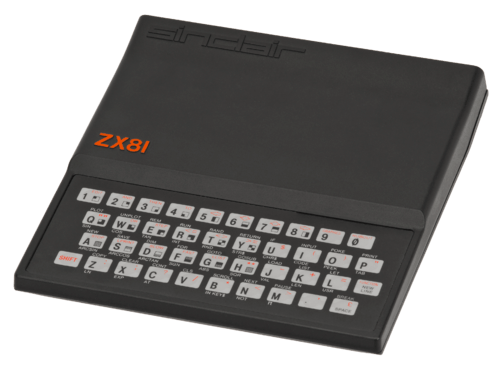
ZX81 Home Computer

Development & Launch (1980–1981) 

  • Autumn 1980: Most of the ZX81’s software was completed, with the remainder of the year spent writing the manual and finalizing hardware.
  • 5 March 1981: Official UK launch at an introductory price of £49.95 for the kit and £69.95 for the pre-assembled machine.
  • October 1981: Launched in the United States at $149.95 assembled and $99.95 in kit form.
  • November 1981: The ZX Printer was released for £49.95, expanding the system’s capabilities. 
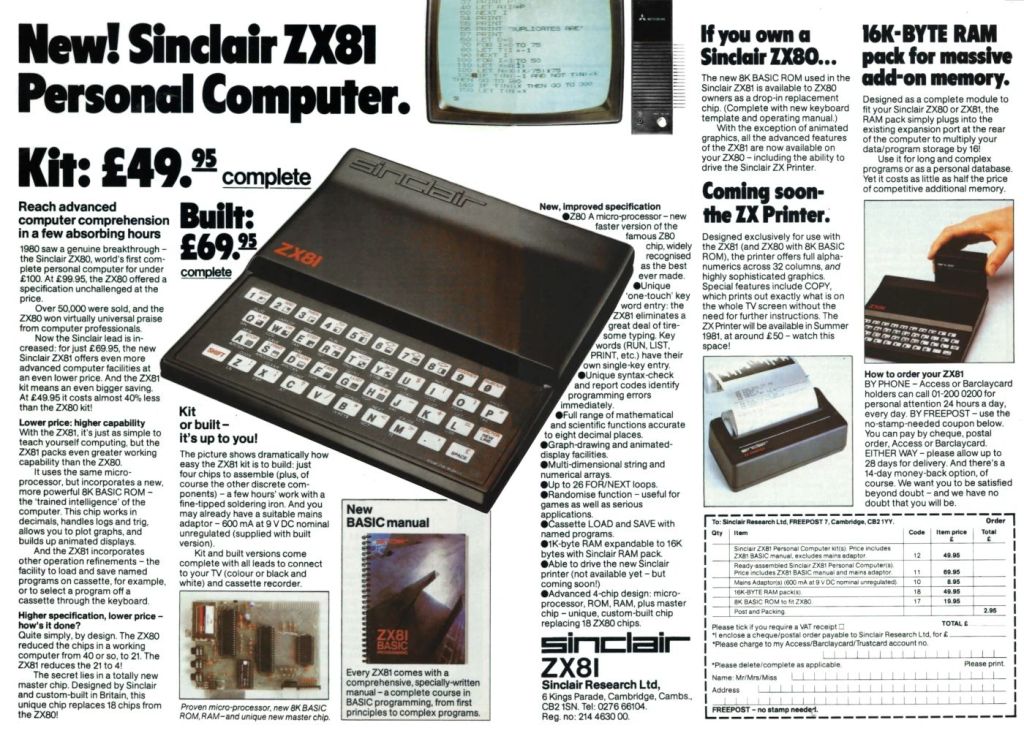
ZX81 Home Computer article

Market Success & Expansion (1982)

  • January 1982: Over 300,000 units had been sold via mail order. American sales reached 15,000 units per month.
  • February 1982: Production reached 40,000 units per month to keep up with massive global demand.
  • July 1982Timex Sinclair 1000 launched in the US as a licensed version of the ZX81, featuring 2KB of RAM (double the original’s 1KB).
  • 1982 Peripheral Boom: Numerous third-party upgrades were released, including the Memopak 64K RAM expansion and various replacement “real” keyboards to solve the frustration of the original membrane design. 

The Shift to Spectrum & Decline (1982–1986) 

  • 23 April 1982: Sinclair launched the ZX Spectrum, the colour-capable successor that would eventually overshadow the ZX81.
  • 1983: Total production of the ZX81 surpassed 1.5 million units worldwide.
  • 1984: The ZX81 was officially discontinued as Sinclair focused on the Spectrum and the ill-fated Sinclair QL.
  • 7 April 1986: Following financial difficulties, Sinclair Research’s computer assets were sold to Amstrad for £5 million.

Sinclair ZX81 Home Computer timeline history

Sinclair ZX Spectrum Timeline History

The ZX Spectrum timeline spans from its revolutionary launch in 1982 to its final official production in 1992, followed by a vibrant modern era of community-driven hardware. 

The Sinclair Era (1982–1986) 

  • 23 April 1982Sinclair Research launches the ZX Spectrum at the Earls Court Computer Show. It features 16 KB (£125) or 48 KB (£175) of RAM, a Z80A CPU, and the iconic rubber “chiclet” keyboard.
  • 1983: Timex Sinclair 2068 is released in the US as a modified version of the Spectrum.
  • October 1984: The ZX Spectrum+ is released for £179. It features a new injection-moulded keyboard similar to the Sinclair QL and a dedicated reset button, but remains electronically identical to the 48K model.
  • September 1985: The ZX Spectrum 128 (“The Toast Rack”) is unveiled at the SIMO trade show in Spain. It introduces 128 KB of RAM, an AY-3-8912 sound chip, and MIDI compatibility.
  • January 1986: The ZX Spectrum 128 officially goes on sale in the UK for £179.95. 

The Amstrad Era (1986–1992) 

  • 7 April 1986Amstrad plc acquires the “Sinclair” brand and all Spectrum assets from Sinclair Research for £5 million.
  • 1986: The ZX Spectrum +2 is released. It features a grey case with a spring-loaded keyboard and a built-in “Datacorder” cassette player.
  • 1987: The ZX Spectrum +3 launches with a built-in 3-inch floppy disk drive, replacing the tape deck. It is the only official Spectrum capable of running the CP/M operating system.
  • 1988–1989: Amstrad releases the +2A+2B, and +3B models, which use unified circuit boards and transition to black cases.
  • 1992: Official production of all ZX Spectrum models is discontinued. 

The Modern Revival (2017–Present)

  • 2017: The ZX Spectrum Next Kickstarter campaign successfully funds a new, officially licensed hardware evolution.
  • February 2020: The first batch of ZX Spectrum Next machines is delivered to backers.
  • November 2023: The ZX Touch, a handheld emulation console, is released.
  • 22 November 2024Retro Games releases “The Spectrum”, a modern HDMI-compatible recreation with 48 built-in games.

ZX Spectrum Timeline History

I owned one of these in the early Eighties…