

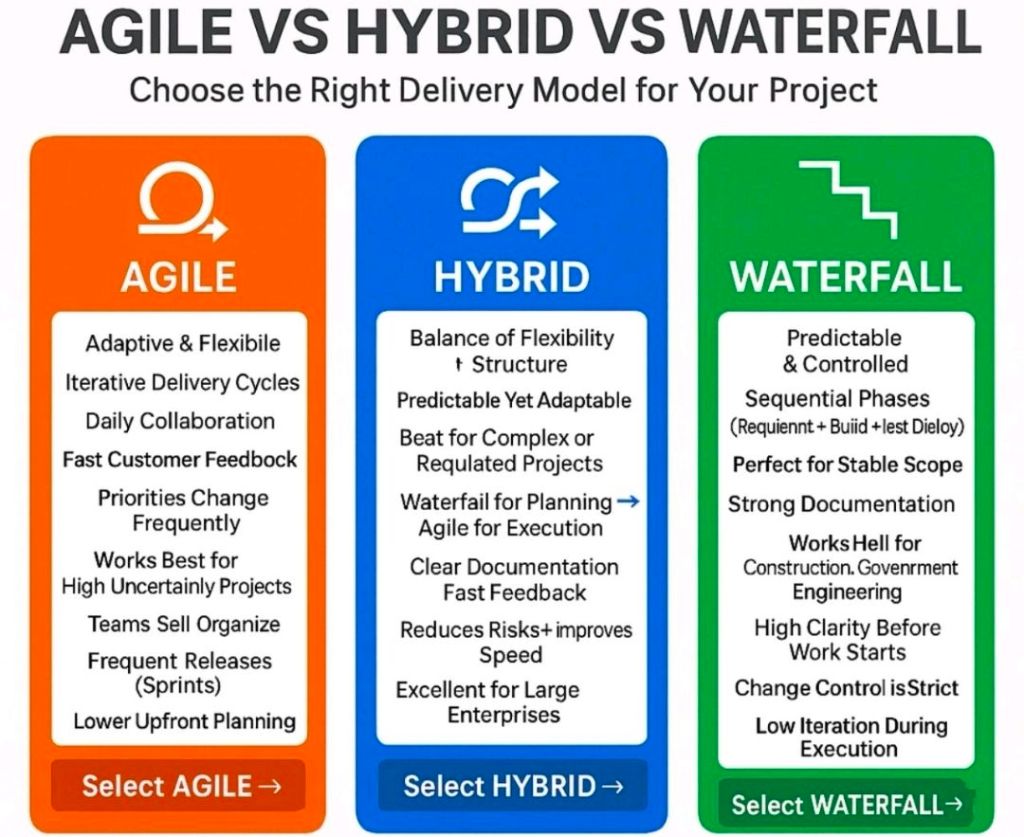
Hybrid Project Management (HPM) is a tailored approach that combines structured, predictive methods—most commonly Waterfall—with flexible, iterative methods like Agile to maximize efficiency, speed, and control. As organizations face increasingly complex, rapid-change environments, HPM allows for detailed upfront planning of scope and budget, while utilizing sprints for development and stakeholder feedback.
Summary of Hybrid Project Management
- Definition: A blended approach merging Waterfall’s discipline with Agile’s adaptability.
- Why It Emerged: To bridge the gap between rigid traditional methods and the high-speed needs of modern, often digital, projects.
- Core Characteristics:
- Predictive Planning: Upfront requirement gathering and high-level scheduling (Waterfall).
- Adaptive Execution: Iterative development, Scrum ceremonies, or Kanban workflows (Agile).
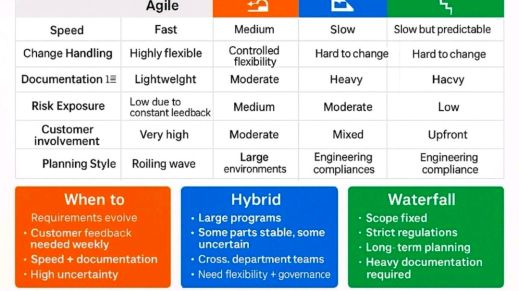
- Fit-for-Purpose: Tailoring the project lifecycle to specific organizational, technical, or regulatory needs rather than using a one-size-fits-all framework.
- When to Use: Projects requiring high predictability for deliverables/compliance (e.g., infrastructure) but requiring flexibility in implementation (e.g., software).
- Benefits: Increased speed, improved resource management, and higher adaptability to change.
Detailed Historical Timeline: Evolution Toward Hybrid
The history of project management shows a progression from early manual techniques to structured “Golden Age” methodologies, eventually diversifying into Agile before merging into modern Hybrid approaches.
I. Pre-Modern Era (Before 1950) – The Birth of Structure
- ~2570 BC: Completion of the Great Pyramid of Giza, demonstrating early massive-scale planning.
- 1910s: Henry Gantt develops the Gantt chart, introducing visual scheduling for tasks, dependencies, and timelines.
- 1931: Hoover Dam project uses early scheduling techniques.
II. The “Golden Age” (1950s-1960s) – Introduction of Predictive Methods
- 1956: The American Association of Cost Engineers (now AACE International) is formed.
- 1957: DuPont Corp develops the Critical Path Method (CPM) to manage complex, repetitive projects.
- 1958: Program Evaluation and Review Technique (PERT) is developed by the US Navy for the Polaris missile project, focusing on handling uncertainty in task durations.
- 1960s: Formalization of the Waterfall method.
- 1962: US Department of Defense mandates the Work Breakdown Structure (WBS).
- 1969: Project Management Institute (PMI) is founded, establishing a standard profession.
III. The “Silver Age” (1970s-1980s) – Diversification & Lean
- 1970: Winston Royce publishes the first formal description of the Waterfall process.
- 1975: PROMPTII method created (the ancestor to PRINCE).
- 1978: Toyota Production System, including early Kanban and Lean principles, gains attention.
- 1984: Theory of Constraints (TOC) introduced by Eliyahu Goldratt.
- 1986: Takeuchi and Nonaka define Scrum as a new product development game.
- 1987: PMI publishes the first Guide to the Project Management Body of Knowledge (PMBOK Guide).
IV. The Digital Age & Agile Revolution (1990s-2000s) – Flexibility
- 1991: Crystal Clear Agile methodology developed.
- 1995: Jeff Sutherland and Ken Schwaber formalize Scrum.
- 1996: PRINCE2 published by the UK Government.
- 1997: Critical Chain Project Management (CCPM) invented.
- 2001: Agile Manifesto published, accelerating the shift toward iterative software development.
- 2000s: Proliferation of project management software (Microsoft Project, Jira, Asana).
V. The Hybrid Era (2010s-Present) – Tailored Integration
- 2010s: Hybrid Methodologies gain popularity, bridging the gap between Waterfall’s rigid structure for milestones and Agile’s flexibility for development.
- 2015-2018: Increased adoption of “ScrumBan” (Scrum + Kanban) and early “Agile-Waterfall” hybrid models.
- 2020s: COVID-19 pandemic acts as a catalyst, forcing remote work and accelerating hybrid adoption for greater resilience.
- 2021-2024: Shift towards “fit-for-purpose” approaches, where projects combine predictive and adaptive lifecycles based on risk and complexity.
- 2024: PMI data shows traditional predictive methods decreasing, while hybrid methodologies rise significantly (over 57% increase) as the dominant project management trend.
- 2025+: Integration of Artificial Intelligence (AI) and automated tools into hybrid frameworks to further refine efficiency.
Hybrid HPM project management summary and detailed historical timeline by era and year

 PROject Templates