

The Creative Arts BA (Hons) at Bangor University is a three-year, full-time course (UCAS code: WPQ3) that integrates film, media, journalism, and creative writing. It is designed to balance theoretical study with practical, hands-on production.
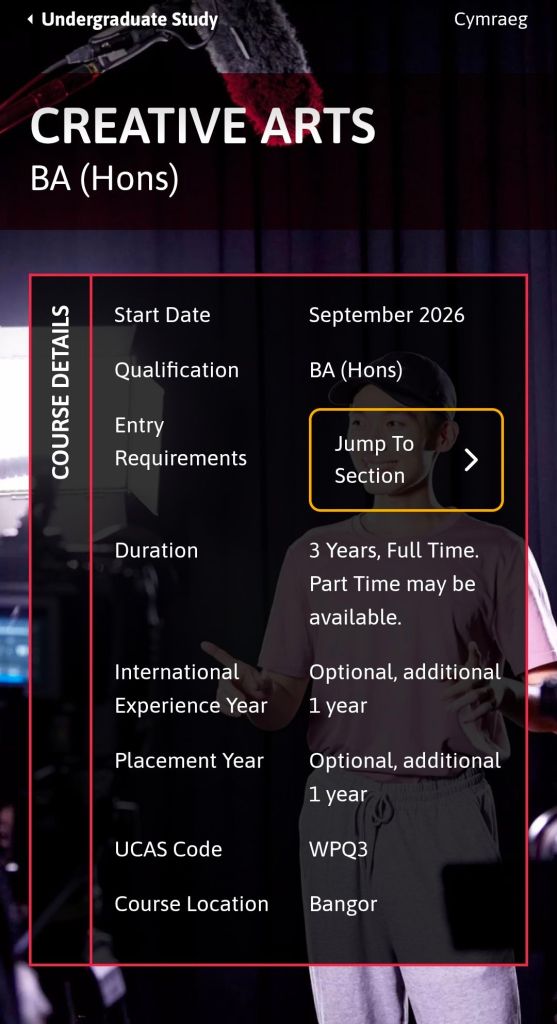
Year 1: Foundations
In the first year, students must complete 120 credits to build a base in both creative practice and academic theory.
- Compulsory Modules: A primary core module is Adventures in the Creative Arts (20 credits), which introduces multidisciplinary approaches to the field.
- Core Skills: You will begin developing production techniques in areas such as audio and visual production, print journalism, and digital media.
- Theoretical Grounding: Introductory modules cover film theory and cultural studies to enrich your research and analytical skills.
Year 2: Specialisation & Development
The second year allows for deeper engagement with specific creative industries.
- Elective Choice: Students can tailor their studies to their interests, choosing between practice-based modules (e.g., screenwriting, documentary filmmaking, journalism practice) or academic-focused modules (e.g., media regulation, history of film).
- Professional Engagement: You are encouraged to build professional networks through regular visits from filmmakers, journalists, and designers.
- Optional Years: After Year 2, you may opt to take an International Experience Year or a Placement Year to work with a professional organisation.
Year 3: Synthesis & Final Project
The final year focuses on high-level production and a significant independent project.
- Final Year Project: Instead of a traditional long-form essay, you can demonstrate your progress through creative outputs such as a fictionalised response, an online exhibition, a vlog, or a professional portfolio.
- Advanced Practice: Modules continue to cover specialized topics like digital journalism, visual culture, and global media.
- Professional Showcase: Students often participate in the annual media showcase held at the Pontio Arts and Innovation Centre, providing exposure for their work.
Teaching & Facilities
- Learning Methods: Instruction is delivered through lectures, small seminar groups, interactive workshops, and one-to-one supervision.
- Facilities: Students have access to industry-standard equipment via an extensive loan service (video/stills cameras, digital recorders) and dedicated creative spaces.
- Assessment: Progress is measured via coursework, presentations, essays, and practical submissions (e.g., short films, scripts, or digital media pieces).
Creative Arts BA (Hons) at Bangor University is a full-time course that integrates film, media, journalism, and creative writing
Bangor University History Timeline by Era and Year
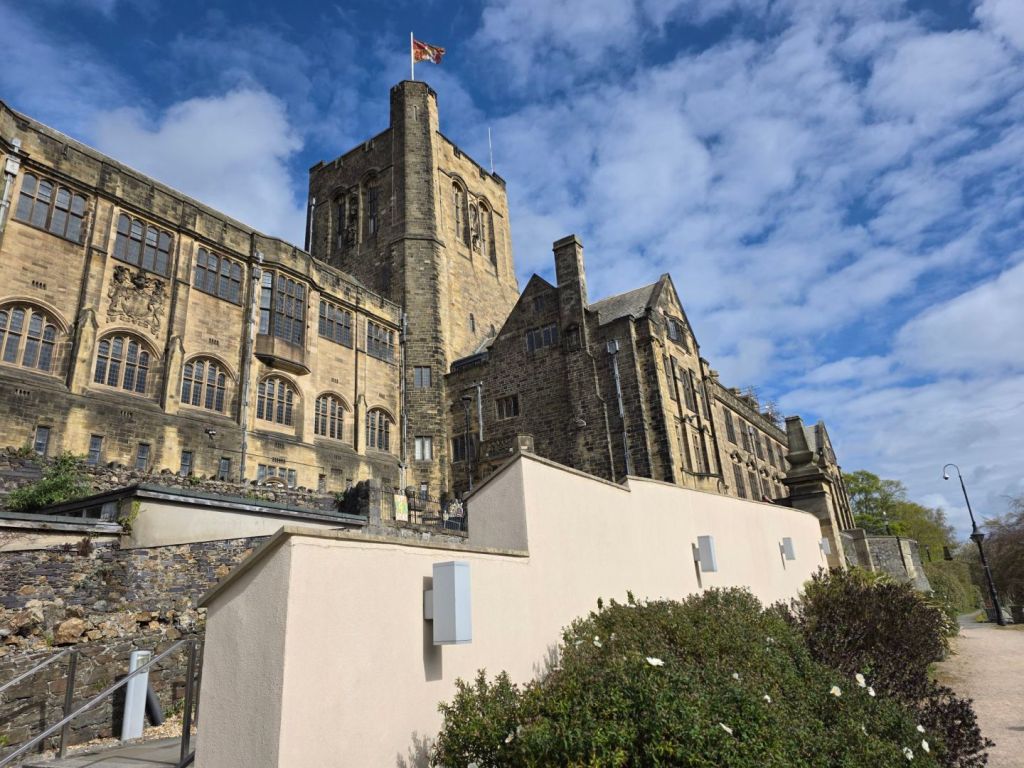
Bangor University (Welsh: Prifysgol Bangor) is a public research university in North Wales, originally founded as the University College of North Wales (UCNW) on 18 October 1884. Established through a historic public campaign, its foundation was uniquely funded by local quarrymen and farmers who contributed their own wages to ensure access to higher education for the people of North Wales.
Today, it is a prominent institution with over 10,000 students and 2,000 staff members, recognised for its research excellence and strong Welsh cultural identity.
Comprehensive Timeline of Bangor University
Era 1: Foundation & Early Years (1881–1899)
- 1881: The Aberdare Report recommends creating two university colleges in Wales, one for the south and one for the north.
- 1883: A committee selects Bangor over 12 other towns (including Wrexham and Rhyl) to host the new college.
- 1884 (18 October): The University College of North Wales officially opens in the Penrhyn Arms, an old coaching inn, with 58 students and 10 staff members.
- 1884: Mary Ellen Williams becomes the first student to enrol; female students notably make up one-third of the initial population.
- 1885: The institution receives its Royal Charter.
- 1893: Bangor becomes a founding constituent college of the federal University of Wales, ending its initial practice of conferring degrees through the University of London.
Era 2: The College on the Hill (1900–1939)
- 1903: The city of Bangor donates a 10-acre site at Penrallt for a new building.
- 1907: King Edward VII lays the foundation stone for the “Main Arts” building.
- 1911: The iconic Main Arts Building (the “College on the Hill”) is officially opened by King George V.
- 1926: The Science Departments, which had remained at the old Penrhyn Arms, move to new purpose-built facilities funded by the North Wales Heroes Memorial.
Era 3: Wartime & Mid-Century Expansion (1940–1999)
- 1940s (WWII): The university’s Prichard-Jones Hall is used to safeguard national art gallery paintings from enemy bombing.
- 1942: Neuadd Reichel, a hostel for male students designed by Percy Thomas, opens on the Ffriddoedd site.
- 1960s: Rapid expansion follows the Robbins Report, including the completion of the “New Arts” wing (1968) and the establishment of new departments like Social Theory (1966).
- 1967: The Bangor Normal College hosts lectures by the Maharishi Mahesh Yogi, attended by The Beatles.
- 1977: St Mary’s College, a women’s teacher training college, merges with the university.
- 1996: The Normal College (founded 1858) officially merges with the university, which is renamed University of Wales, Bangor.
Era 4: Independence & Modern Era (2000–Present)
- 2003: Storm FM, the official student radio station, begins broadcasting.
- 2007: The institution gains independent university status and adopts its current name, Bangor University.
- 2009: The university celebrates its 125th anniversary and begins awarding its own degrees independently of the University of Wales.
- 2015: The Pontio Arts and Innovation Centre and St Mary’s Student Village open.
- 2018: The M-SParc science park on Anglesey is completed.
- 2024: The university celebrates its 140th anniversary and opens its independent North Wales Medical School with its first intake of 80 students.
- 2025: A £10.5 million donation leads to the redevelopment and renaming of the Albert Guday Business School.

 PROject Templates