

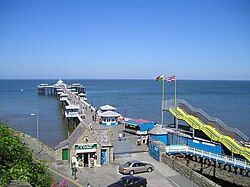
Llandudno Pier, often called the “Queen of Welsh Piers”, is the longest pier in Wales at 2,295 feet (700 metres). It is a Grade II* listed structure renowned for its Victorian and Edwardian elegance, featuring ornate ironwork and classic kiosks.

Historical Timeline by Era
Early Origins (The Pre-Pier Era)
- 1858: A short wooden pier (242 ft) was built by the St George’s Harbour and Railway Company to export limestone.
- 1859: This original structure was severely damaged by the “Royal Charter Storm”.
- 1860–1875: Though repaired, the wooden pier was too short for steamships except at high tide.
Victorian Era: Construction and Growth
- 1875: The Llandudno Pier Company was formed to build a new, modern structure.
- 1876: Construction began in June/July. The first pile was driven on 16 September 1876.
- 1877: The pier officially opened on 1 August, initially measuring 1,234 feet.
- 1878: Construction was fully completed; the first steamboat (Prince Arthur) landed in May.
- 1884: A landward extension was added, bringing the pier to its current length of 2,295 feet.
- 1886: The Pier Pavilion opened on 16 September as a 2,000-seat theatre and concert hall.
- 1887: Renowned conductor Jules Rivière took charge of the pier’s orchestra, which eventually grew to symphony proportions.
- 1891: A new landing stage was added to accommodate increased steamship traffic.
Edwardian and Mid-20th Century
- 1905: A pier-head pavilion was constructed.
- 1910: Extensive improvements were made, including widening most of the pier.
- 1938: Major alterations were carried out on the landing stage.
- 1968: The pier was purchased by the Trust House Forte Group.
- 1969: The landing stage was totally rebuilt in concrete and steel to handle large Isle of Man steamers.
Modern Era: Challenges and Restoration
- 1983: The pier became part of the First Leisure Corporation.
- 1984: The Pier Pavilion theatre closed.
- 1994: A major fire destroyed the Pier Pavilion on 13 February, leaving only the iron supports.
- 1998: Purchased by Leisure Parks Ltd (Trevor Hemmings) along with several other UK piers.
- 2005: Voted “Pier of the Year” by the National Piers Society.
- 2015: Purchased by local entrepreneur Adam Williams (Tir Prince Leisure Group) for £4.5 million.
- 2021: Adam Williams purchased the derelict Pavilion site to protect the pier’s future.
- 2025: Voted “Pier of the Year” for the second time following major restoration efforts.
Llandudno Pier Overview and Historical Timeline by Era

 PROject Templates