

Critical Chain Project Management (CCPM) represents a paradigm shift in how timelines are managed, moving away from traditional task-based safety to system-wide buffers. Its history is deeply rooted in the Theory of Constraints (TOC) and evolved through four primary eras of modern project management.
The Foundations: Pre-1958
Before the formal creation of CCPM, the industry relied on “craft-based” approaches and the early Gantt Chart (1910s) to visualize task durations. During this era, projects like the Hoover Dam (1931) and the Manhattan Project proved that large-scale coordination was possible, but they lacked a systematic way to handle resource constraints or project-wide uncertainty.
The Traditional Era: 1958 – 1979
This period saw the birth of the “Critical Path,” the ancestor of the “Critical Chain.”
- 1957: The Critical Path Method (CPM) was invented by the DuPont Corporation to manage chemical plant maintenance.
- 1958: The Program Evaluation Review Technique (PERT) was developed for the U.S. Navy’s Polaris Project, introducing probabilistic task durations.
- The Limitation: While these methods identified the longest sequence of tasks, they often ignored resource availability, leading to frequent delays and “multitasking” inefficiencies.
The Conceptual Era: 1980 – 1994
The theoretical seeds for CCPM were planted during the rise of the personal computer and the introduction of a new management philosophy.
- 1984: Dr Eliyahu M. Goldratt published his seminal business novel, The Goal, introducing the Theory of Constraints (TOC).
- Core Principle: Goldratt argued that every system has at least one constraint that limits its output. Managing this “bottleneck” is the key to overall performance.
- Focus Shift: Organizations began looking at “flow” rather than just individual task completion.
The CCPM Era: 1995 – Present
CCPM was formally introduced as a distinct methodology to address the failures of traditional CPM.
- 1997: Goldratt published the book “Critical Chain”, officially launching the method.
- Key Innovations: Unlike CPM, the Critical Chain accounts for both task dependencies and resource constraints. It replaced individual task “safety margins” with:
- Project Buffers: A collective time safety net placed at the end of the project.
- Feeding Buffers: Placed where non-critical tasks feed into the critical chain to prevent delays.
- Fever Charts: A new visual tool for tracking buffer consumption rather than just task deadlines.
- Modern Integration: In the 21st century, CCPM has been integrated with Agile and Lean practices to help organizations manage multi-project pipelines and global resource pools.
Critical Chain Project Management (CCPM) timelines differ from traditional methods by shifting safety margins from individual tasks to strategic buffers at the end of the project or at integration points. This approach accounts for both task dependencies and resource constraints to determine the “Critical Chain”—the true longest path in a project.
Core Components of a CCPM Timeline
- The Critical Chain: The longest sequence of dependent tasks, adjusted for resource availability.
- Aggressive Task Estimates: Tasks are estimated at a 50% confidence level (how long it takes if things go well) rather than the traditional 90% (safe) estimate.
- Project Buffer: A single aggregate buffer placed at the very end of the project to protect the final delivery date.
- Feeding Buffers: Placed at points where non-critical task sequences (feeding chains) merge into the critical chain, preventing delays in minor tasks from affecting the main timeline.
- Resource Buffers: Virtual markers or alerts placed before critical tasks to ensure that key resources (people or equipment) are ready to start exactly when needed.
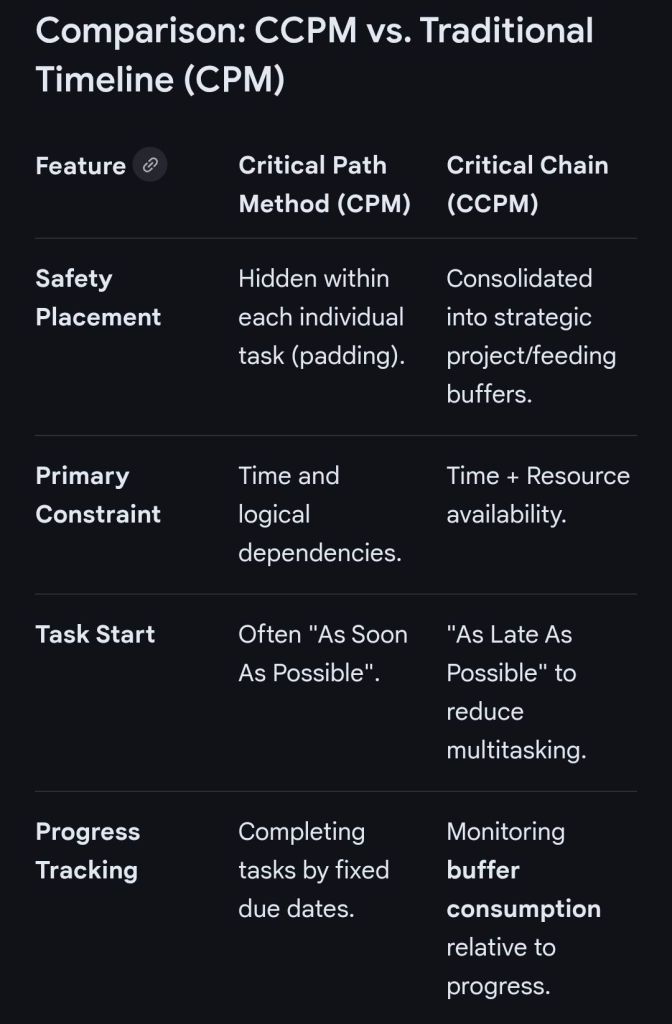
Implementing a CCPM Timeline
- Identify the Critical Path: Map the logical sequence of tasks.
- Level Resources: Adjust the schedule so no single resource is over-allocated, transforming the path into a Critical Chain.
- Strip Task Padding: Reduce task durations by roughly 50% to eliminate “Student Syndrome” (procrastinating until the last minute).
- Insert Buffers: Add a Project Buffer (typically 50% of the chain’s length) at the end and Feeding Buffers where non-critical paths merge.
- Monitor via Fever Chart: Use a Fever Chart to track if the buffer is being consumed faster than tasks are being completed.
Critical Chain Project Management (CCPM) Overview and Timeline

 PROject Templates