

The Sinclair ZX81 was a seminal moment in home computing, launched in March 1981 as the successor to the ZX80. It was designed by Sinclair Research to be a low-cost entry point into computing, famously costing less than £70 (or £50 as a self-assembly kit).
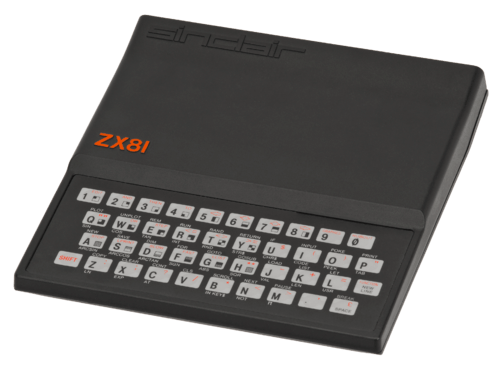
Development & Launch (1980–1981)
- Autumn 1980: Most of the ZX81’s software was completed, with the remainder of the year spent writing the manual and finalizing hardware.
- 5 March 1981: Official UK launch at an introductory price of £49.95 for the kit and £69.95 for the pre-assembled machine.
- October 1981: Launched in the United States at $149.95 assembled and $99.95 in kit form.
- November 1981: The ZX Printer was released for £49.95, expanding the system’s capabilities.
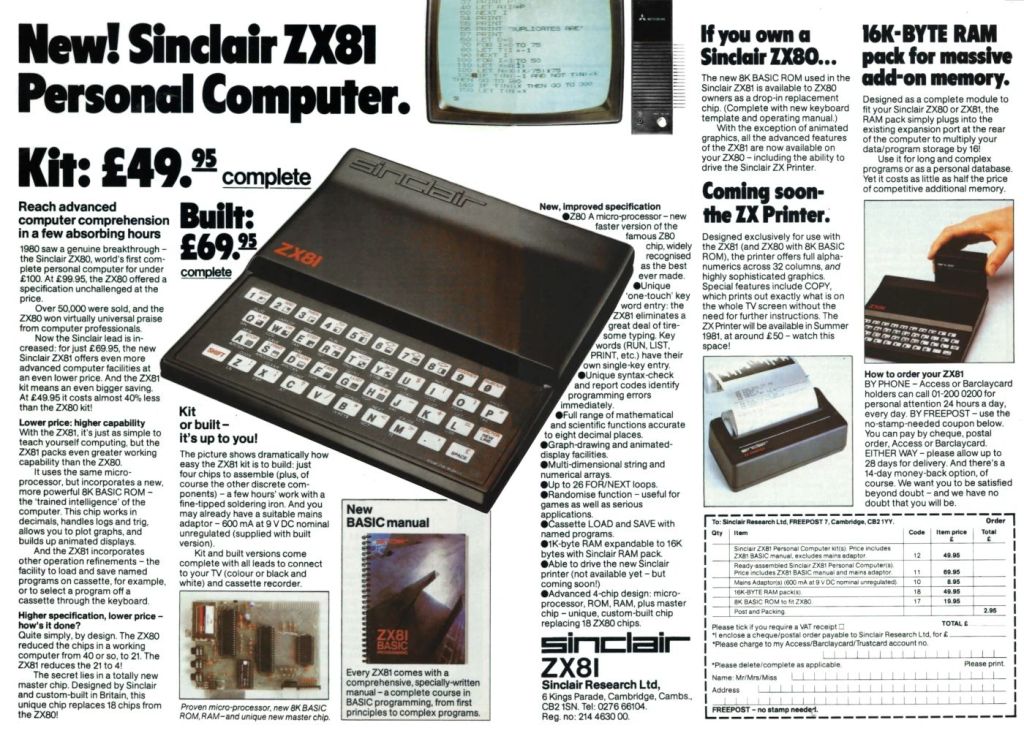
Market Success & Expansion (1982)
- January 1982: Over 300,000 units had been sold via mail order. American sales reached 15,000 units per month.
- February 1982: Production reached 40,000 units per month to keep up with massive global demand.
- July 1982: Timex Sinclair 1000 launched in the US as a licensed version of the ZX81, featuring 2KB of RAM (double the original’s 1KB).
- 1982 Peripheral Boom: Numerous third-party upgrades were released, including the Memopak 64K RAM expansion and various replacement “real” keyboards to solve the frustration of the original membrane design.
The Shift to Spectrum & Decline (1982–1986)
- 23 April 1982: Sinclair launched the ZX Spectrum, the colour-capable successor that would eventually overshadow the ZX81.
- 1983: Total production of the ZX81 surpassed 1.5 million units worldwide.
- 1984: The ZX81 was officially discontinued as Sinclair focused on the Spectrum and the ill-fated Sinclair QL.
- 7 April 1986: Following financial difficulties, Sinclair Research’s computer assets were sold to Amstrad for £5 million.
Sinclair ZX81 Home Computer timeline history

 PROject Templates