

The Scaled Agile Framework (SAFe) is a set of organization and workflow patterns intended to guide enterprises in scaling lean and agile practices across large-scale software and systems development. Created by Dean Leffingwell in 2011, it combines Agile development, Lean product development, and systems thinking to enable alignment, collaboration, and delivery across hundreds or thousands of practitioners.
SAFe Project Management Summary
SAFe structures project management across multiple levels to bring agility to the enterprise:
- Team Level: Scrum or Kanban teams operate in 2-week iterations (sprints) to deliver working software.
- Program Level (Agile Release Train – ART): A “team of teams” (typically 50-125+ people) aligns to a common mission, planning, and releasing together on a fixed cadence, usually via Program Increments (PIs) lasting 8–12 weeks.
- Portfolio Level: Aligns strategy to execution, managing investment themes (Epics) through Lean Portfolio Management.
- Core Values & Principles: SAFe is grounded in 10 principles (e.g., “Take an economic view,” “Apply systems thinking”) and four core values: Alignment, Built-in Quality, Transparency, and Program Execution.
Historical Timeline by Era and Version
The evolution of SAFe tracks the growing need for business agility and faster delivery in complex organizations.
1. Foundation & Initial Concept (2007–2010)
- 2007–2008: Dean Leffingwell publishes Scaling Software Agility, laying the foundation for enterprise agile patterns.
- 2010: Agile Software Requirements is published, bridging Agile with enterprise needs.
2. The Early Years: SAFe 1.0 – 2.0 (2011–2013)
- 2011: SAFe 1.0 released, initially termed “Agile Enterprise Big Picture,” focusing on applying Scrum/XP at scale.
- 2012: SAFe 2.0 (October) released to restructure portfolio and program levels.
- 2013: Initial refinements to the “Big Picture” to better integrate lean principles.
3. Expansion: SAFe 3.0 – 4.0 (2014–2016)
- 2014: SAFe 3.0 introduced, introducing more emphasis on DevOps and faster, value-driven delivery.
- 2016: SAFe 4.0 launched, introducing a dedicated “Value Stream” level for larger, complex systems and enhancing Kanban adoption.
4. The Enterprise & DevOps Era: SAFe 4.5 – 4.6 (2017–2018)
- 2017: SAFe 4.5 released, emphasizing Lean Startup techniques, Lean UX, and faster, more flexible “Essential SAFe” configuration.
- 2018: SAFe 4.6 updated to further incorporate the “Five Core Competencies of the Lean Enterprise”.
5. Business Agility Era: SAFe 5.0 – 5.1 (2020–2021)
- 2020: SAFe 5.0 (January) released, focusing on “Business Agility,” expanding agile principles beyond IT to the entire business (Human Resources, Finance, etc.).
- 2021: SAFe 5.1 introduced, with enhanced focus on distributed teams, DevOps, and Accelerate metrics.
6. AI & Continuous Learning Era: SAFe 6.0 (2023–Present)
- 2023: SAFe 6.0 (March) released, providing updated guidance on AI, Big Data, and Cloud technologies, while enhancing flow-based planning and accelerating value delivery.
- 2024/2025: Focus on “AI-Empowered” SAFe, integrating artificial intelligence into the framework’s roles and ceremonies.
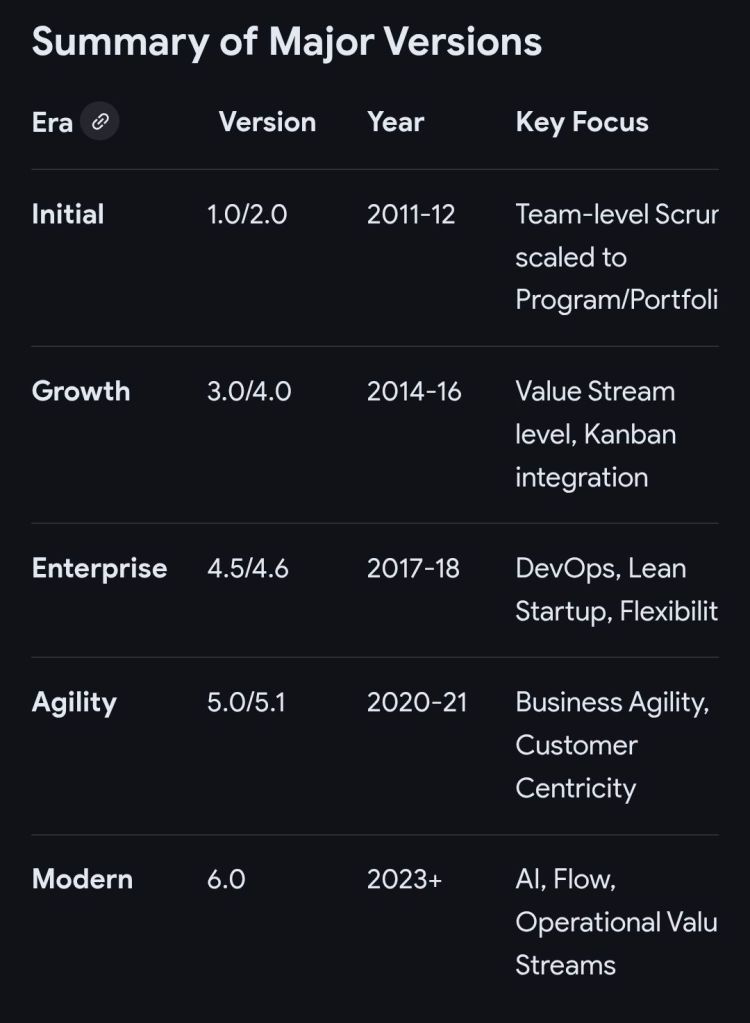
SAFe Scaled Agile Framework summary and detailed historical timeline by era and year

 PROject Templates