

The HPE NonStop architecture is defined by its “shared-nothing” design, where every hardware and software component is redundant and operates independently to ensure 100% operational continuity. For over 40 years, it has evolved through four distinct hardware eras while maintaining upward software compatibility.
1. The Tandem Era (1974–1997): Proprietary Foundations
- Architecture Approach: Founded by James Treybig, Tandem introduced the first commercial fault-tolerant system using a proprietary 16-bit stack-based architecture.
- Key Technical Milestones:
- 1976 (NonStop I/T16): Introduced the Dynabus, a custom inter-processor backplane, and the Guardian OS, which used message-passing instead of shared memory to isolate faults.
- 1981–1983 (NonStop II & TXP): Introduced 32-bit addressing and the Transaction Monitoring Facility (TMF), which allowed applications to be fault-tolerant without specialized coding.
- 1986–1989 (VLX & Cyclone): Scaled to the mainframe market with ECL gate-array chips and the first fault-tolerant relational database, NonStop SQL.
2. The MIPS Era (1991–2004): Migration to RISC
- Architecture Approach: To keep pace with industry performance, Tandem transitioned from proprietary processors to off-the-shelf MIPS RISC processors while emulating the original instruction set for compatibility.
- Key Technical Milestones:
- 1991 (Cyclone/R): The first MIPS-based system.
- 1997 (Himalaya S-Series): Replaced Dynabus with ServerNet, a high-speed system interconnect that later evolved into the industry-standard InfiniBand.
- Ownership Shift: Compaq acquired Tandem in 1997, and HP merged with Compaq in 2002.
3. The Itanium Era (2005–2013): HP Integrity NonStop
- Architecture Approach: Branded as Integrity NonStop (NonStop i), this era moved the platform to Intel Itanium processors.
- Key Technical Milestones:
- 2005 (NS-series/J-series): Focused on “NonStop Advanced Architecture” (NSAA), leveraging standard HP server components to lower costs while maintaining Availability Level 4 (AL4).
- Technical Commentary: While powerful, the reliance on Itanium’s EPIC architecture eventually limited growth as the industry consolidated around x86-64.
4. The Modern HPE Era (2014–Present): x86-64 & Virtualization
- Architecture Approach: Shifted to standard Intel x86-64 processors (NonStop X), fully decoupling the software stack from proprietary hardware.
- Key Technical Milestones:
- 2014 (NonStop X/TNS/X): Introduced the L-series operating system. The architecture transitioned to a standard InfiniBand fabric for inter-processor communication.
- 2017–2020 (vNS): Launched Virtualized NonStop (vNS), allowing the environment to run on standard hypervisors like VMware, bringing fault tolerance to private and hybrid clouds.
- 2025 (NS9 X5): Modern systems now support up to 8 TB of RAM and are integrated into the HPE GreenLake consumption-based cloud model.
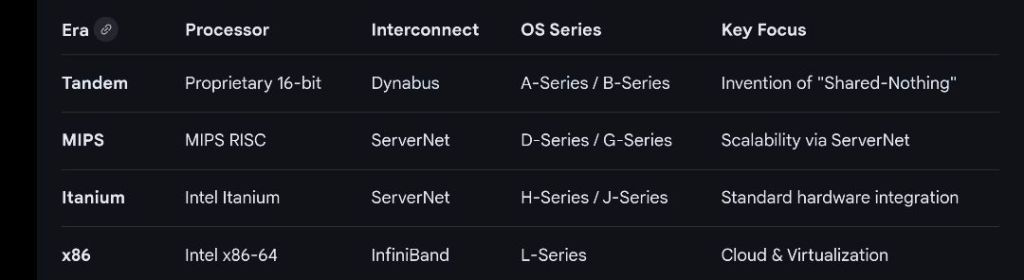
- Summary of Architectural Evolution

 PROject Templates