

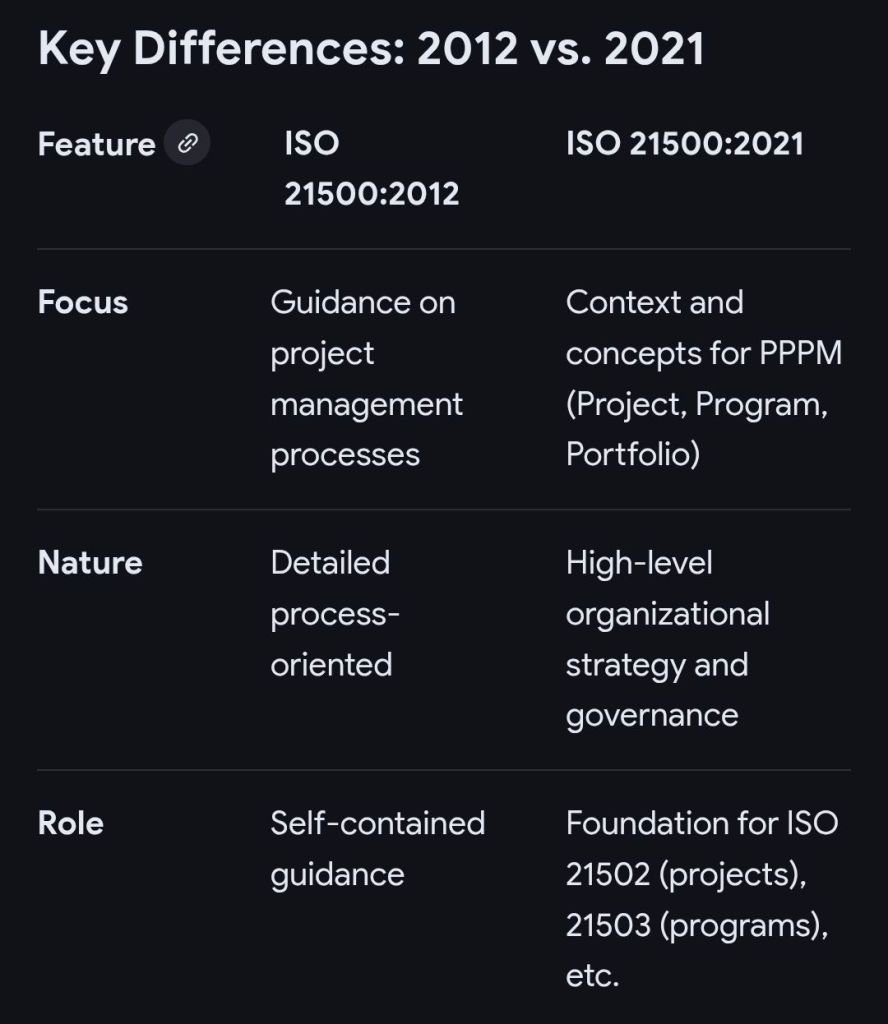
ISO 21500 is a set of international standards providing high-level guidance on project, program, and portfolio management. Initially published in 2012 as a guidance document for project management, it was updated in 2021 to serve as the foundational, high-level “Context and Concepts” document for a broader suite of ISO project management standards (ISO 21500–21505).
ISO 21500 Development Timeline
- 2007: The ISO Technical Committee ISO/TC 258 (Project, programme and portfolio management) began working on a global project management standard.
- September 2012: ISO 21500:2012 (Guidance on Project Management) was officially published, providing a generic framework for project management and a common language for professionals.
- 2017: Work intensified on updating the standard to reflect new best practices and to transition into a family of standards (21500-21505).
- 2020: ISO 21502:2020 was published, taking over the detailed guidance on project management formerly covered by ISO 21500:2012.
- March 2021: ISO 21500:2021 (Project, programme and portfolio management – Context and concepts) was released, replacing the 2012 edition, with a focus on defining the overarching environment for project management rather than specific processes.
Detailed Historical Timeline of Project Management
The following timeline details the evolution of project management leading up to the ISO standards.
1. Ancient Era – Pre-1900: Foundation & Construction
- Ancient Times: The pyramids of Giza, the Great Wall of China, and Roman infrastructure demonstrated early, sophisticated, large-scale project management.
- 1896: Carol Adami developed the harmonogram, a precursor to visualization tools.
2. Early Modern Era (1900–1950): Scheduling Techniques
- 1910-1915: Henry Gantt developed the Gantt Chart, revolutionizing scheduling by tracking project progress visually.
- 1940s: Large-scale projects, such as the Manhattan Project, pioneered modern, integrated project teams.
3. The Golden Age (1950–1980): Formalization
- 1957: DuPont introduced the Critical Path Method (CPM) for chemical plant construction.
- 1958: The U.S. Navy developed PERT (Program Evaluation and Review Technique) for the Polaris missile project.
- 1962: U.S. Department of Defense mandated Work Breakdown Structures (WBS).
- 1965: Founding of the International Project Management Association (IPMA).
- 1969: Founding of the Project Management Institute (PMI).
4. The Silver Age (1980–2000): Methodologies & Technology
- 1984: Eliyahu Goldratt published “The Goal,” introducing the Theory of Constraints (TOC).
- 1986: Takeuchi and Nonaka defined Scrum as a flexible, holistic product development strategy.
- 1987: PMI published the first Project Management Body of Knowledge (PMBOK) guide.
- 1989: The UK government developed PRINCE (Projects in Controlled Environments), later evolving into PRINCE2.
- 1995: Scrum was formalized for software development by Jeff Sutherland and Ken Schwaber.
- 1996: PMI published the first official edition of the PMBOK Guide.
5. Modern Era (2000–Present): Agile & Global Standardization
- 2001: Publication of the Agile Manifesto, highlighting flexible and user-focused development.
- 2007: ISO began developing international project management standards.
- 2012: ISO 21500:2012 published, providing a global, standard-agnostic guide for project management.
- 2017: The Association for Project Management (APM) received a Royal Charter.
- 2020-2021: Shift towards Agile and hybrid methodologies; PMI released PMBOK 7th Edition, focusing on principles over processes.
- 2021: ISO 21500:2021 (updated) and ISO 21502:2020 (detailed guidance) were established as the new global standard for project management.
ISO 21500 high-level guidance on project, program, and portfolio management

 PROject Templates