

The Adaptive Project Framework (APF), often called Adaptive Project Management (APM), is a flexible, client-driven methodology designed to handle high-complexity, high-uncertainty projects where goals are clear but the methods to achieve them are not. Unlike traditional “Waterfall” approaches that follow rigid, linear plans, APF embraces change, utilizing iterative cycles to learn from previous results and improve future project practices.
Summary of Adaptive Project Framework (APF)
- Core Philosophy: “Think like a chef, not a cook.” APF adapts to the situation rather than strictly following a pre-written recipe.
- Key Principles:
- Client-driven: The client is a co-manager, determining next steps and adjusting scope.
- Thrive on change: Change is expected and embraced, not resisted.
- Iterative Cycles: Work is done in short cycles (“iterations”), with deliverable reviews at the end of each.
- Learn by doing: The project strategy evolves based on learning from the outcomes of previous cycles.
- Maximize Business Value: Focuses only on tasks that add value, reducing non-value-added work.
- Core Characteristics:
- Adaptive Scope: Scope is not fixed; it is continuously adjusted.
- Just-in-Time Planning: Plans are made in detail only when needed, not months in advance.
- Continuous Feedback: Regular checkpoint reviews with the customer.
- The 5 Step APF Process:
- Project Scope: Defining the “Conditions of Satisfaction” (CoS).
- Cycle Schedule: Planning the iterative work.
- Cycle Build: Carrying out the work.
- Client Checkpoint: Reviewing deliverables and revising the plan.
- Final Report: Evaluating success and gathering lessons.
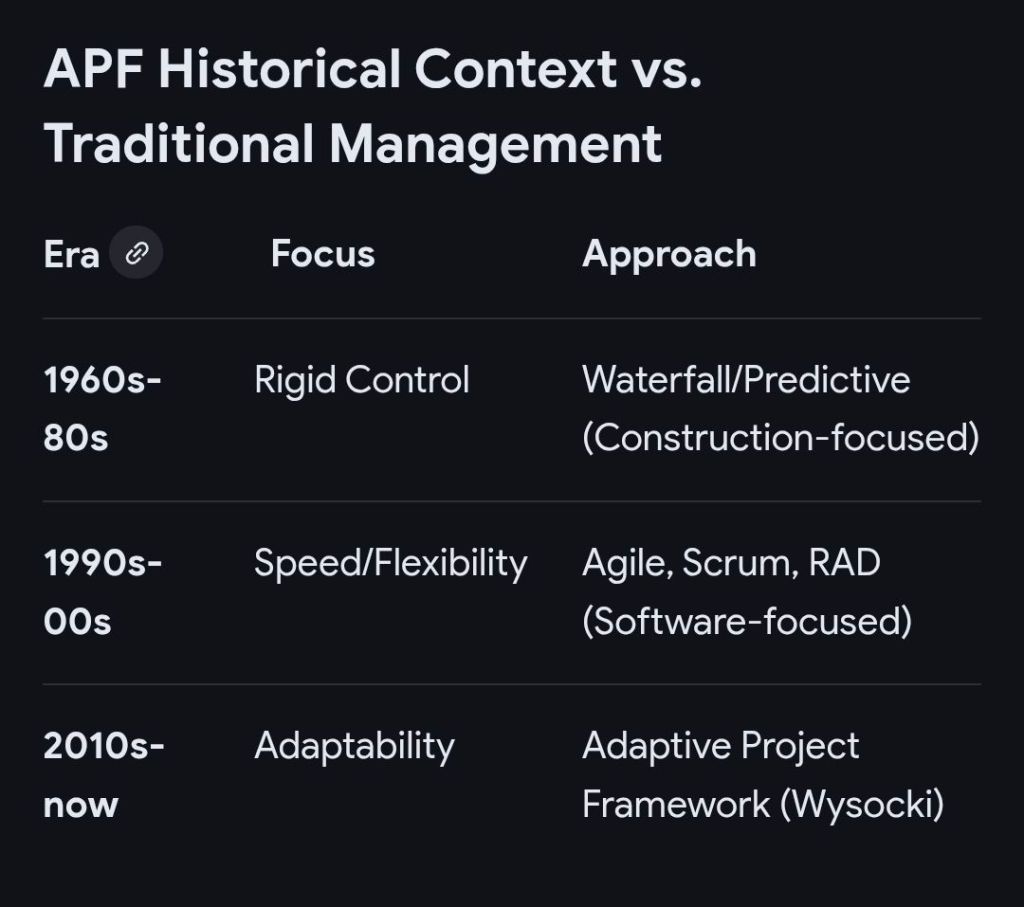
Historical Timeline of Adaptive Project Management
Adaptive project management evolved to address the limitations of traditional, rigid project management when faced with the rapid change and high uncertainty of the 21st-century IT landscape.
Pre-Adaptive Era (Pre-1950s)
- 1917: Henry Gantt develops the Gantt chart, pioneering rigid scheduling.
- Pre-1950s: Project management is informal, experience-driven, and relies heavily on one-time planning.
Early Evolution of Iterative Methods (1950s–1980s)
- 1957: Critical Path Method (CPM) invented by Dupont.
- 1958: Program Evaluation Review Technique (PERT) developed for complex US Navy projects.
- 1975: First inklings of iterative techniques appear (e.g., iterative and evolutionary development).
- 1986: Scrum is named and described as a new style of managing projects.
Rise of Agile and Pre-APF Adaptive Models (1990s)
- 1991: Rapid Application Development (RAD) is described, linking timeboxing with iterations.
- 1994: The CHAOS Report is first published, highlighting the high failure rate of traditional projects, driving the need for better methods.
- 1995: Scrum is introduced formally by Jeff Sutherland and Ken Schwaber.
- 1997: Extreme Programming (XP) and Critical Chain Project Management (CCPM) emerge.
Formalization of Agile and Adaptive Concepts (2000s)
- 2001: The Agile Manifesto is signed, formalizing iterative, client-focused development.
- 2002–2004: A surge of adaptive techniques, including Radical Project Management, Extreme Project Management, and Agile Project Management.
The Development of APF (2010s-Present)
- 2010: Robert K. Wysocki publishes Adaptive Project Framework: Managing Complexity in the Face of Uncertainty, formally defining the APF methodology.
- 2010s-2020s: Shift toward “adaptive project management” in HR and business transformation to thrive in high-uncertainty environments.
- 2022-2025: Increased emphasis on automated data-driven decision-making within APF to maximize efficiency.
 PROject Templates